
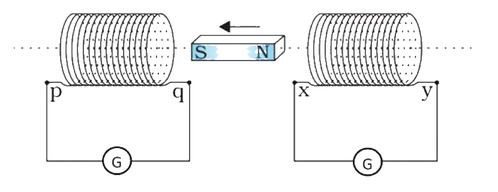
A magnet bar placed along the axis of two identical coils moves towards left with constant speed. Then
(A) The end q of the first coil acquires south(S) polarity.
(B) The end x of the second coil acquires northern (N) polarity
(C) The induced current will be produced in first coil pq only.
(D) Induced current of same magnitude will be produced in both the coils.
Choose the correct answer from the options given below.
Answer & explanation
Correct answer: option 3
The correct answer is Option (3) → (A) and (D) only
Note: The given answer is as per the official NTA Answer Key. However, none of the given options appears to be correct, because statement (D) is true only in one particular position of the magnet, as explained below.
By Lenz’s law, the induced current opposes the change causing it. The magnet moves left: its S pole approaches end q and its N pole moves away from end x.
(A) The end q of the first coil acquires south(S) polarity. — Correct. An approaching S pole is opposed by repulsion, so end q becomes an S pole.
(B) The end x of the second coil acquires northern (N) polarity — Incorrect. A receding N pole is opposed by attraction, so end x becomes an S pole.
(C) The induced current will be produced in first coil pq only. — Incorrect. The flux changes in both coils, so a current is induced in both.
(D) Induced current of same magnitude will be produced in both the coils. — Correct as per NTA; however, it is not correct as a general statement. The induced current depends on the rate of change of flux, which is larger in the coil nearer the magnet. The currents are equal only when the magnet is midway between the identical coils, and the question does not say so.
So strictly only (A) is correct, but “(A) only” is not an option; NTA’s Option (3) treats (D) as correct.