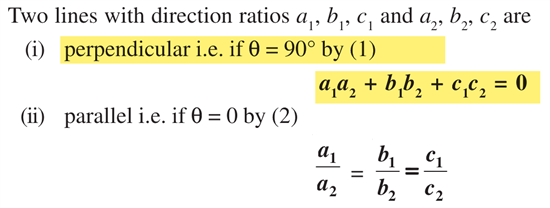
If \( \vec{a} \) and \( \vec{b} \) are two perpendicular vector whose direction ratios are \( (a_1,b_1,c_1) \) and \( (a_2,b_2,c_2) \), then which of the following is a true statement?
Answer & explanation
Correct answer: option 2
The correct answer is Option (2) → \( a_1a_2+b_1b_2+c_1c_2=0 \)
Perpendicular vectors have zero dot product, and in terms of direction ratios the dot product is \( a_1a_2+b_1b_2+c_1c_2 \) (up to a non-zero factor).
\( \displaystyle \vec{a}\perp\vec{b}\;\Rightarrow\;a_1a_2+b_1b_2+c_1c_2=0 \)
NCERT (2026-27 edition):
Angle between Two Lines