CUETMOCK
  • Pricing
  • Mentors
Log inStart freeStart free mocks→

First test, then trust

Try a free CUET mock test.

Join 5,00,000+ students who rehearsed exam day on the exact NTA screen before sitting CUET. On the web and on Android.

Start free mocks →Get the Android app
CUETMOCK

India's #1 CUET Mock Test Platform. Original NCERT-based questions on the exact NTA exam screen — trusted by 5,00,000+ students since CUET 2022.

Get it onGoogle PlayScan to download the CUETMOCK app

Mock tests

  • CUET mock test series
  • Browse all papers
  • Commerce mocks
  • Humanities (Arts) mocks
  • Science mocks
  • Languages & GAT mocks
  • Free practice questions
  • Pricing

Resources

  • CUET exam guide
  • CUET syllabus
  • Universities accepting CUET
  • Expert blogs
  • News & notifications
  • Webinars & counselling
  • CUET score calculator
  • How we estimate your rank
  • FAQs

Company

  • About us
  • Our leadership & team
  • Our toppers
  • Mentors
  • For schools
  • Contact us
  • Terms
  • Privacy
  • Refund policy

Talk to us

+91 7696 6630 56info@cuetmock.comWhatsApp us

Our other platforms

  • JEE Mock — For IIT-JEE aspirants
  • NEET Mock — For NEET aspirants

Newsletter

Exam updates, study material and offers — no spam.

© 2026 NYC Ventures Pvt. Ltd.

701-702, Royal Business Park, Zirakpur, Punjab - 140603

  • Terms of use
  • Privacy policy
  • Refund policy
  • Contact us

iCUETMOCK is an independent preparation platform, not affiliated with the National Testing Agency (NTA). Always check exam details on the official NTA website.

  • Home
  • Mock tests
  • CUET guide
  • Pricing
  • Log in
Home/Practice questions/History
HistoryAncient India: Bricks, Beads and Bones

What kind of materials were used to cover the street drains of Harapp…

What kind of materials were used to cover the street drains of Harappan civilisation?

Answer & explanation+

Correct answer: option 1

The correct answer is Option (1) → Bricks and Limestone

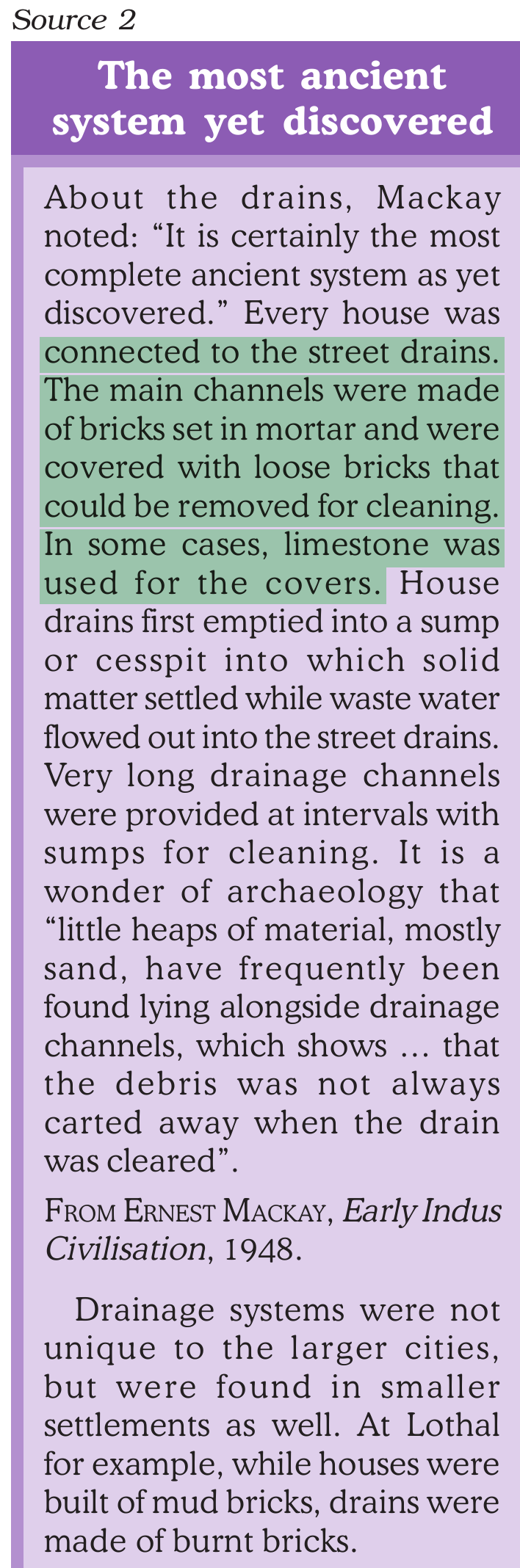
The drainage system of the Harappan cities was very well planned: every house was connected to the street drains. The main channels were made of bricks set in mortar and were covered with loose bricks that could be lifted for cleaning. In some cases, limestone was used for the covers.


NCERT: Themes in Indian History Part I — Chapter 1: Bricks, Beads and Bones (2025-26)

NCERT extract

Advertisement

Practise more on Ancient India: Bricks, Beads and Bones

Chapter-wise mocks on the real NTA exam screen, with solutions and your rank. Your first mocks are free.

Start free mocks →

Advertisement

Next questions

  1. Globalisation as a concept fundamentally deals with-Political Science · Contemporary World Politics: Globalisation
  2. When the Chinese pilgrim Xuan Zang visited the city in the seventh-century CE, he found it in ruins, and with a very small population. Iden…History · Ancient India: Kings, Farmers and Towns
  3. Which factor affecting the financing decision was taken into consideration by the consultant?Business Studies · Financial Management
  4. Which of the following is/are correct?A. ∫ e^x≤ft[displaystyle1/((x-2))-displaystyle1/((x-2)^2)]dx=(e^x)/((x-2))+C , where C is an arbitrar…Maths. Section A · Indefinite Integration
  5. Find out the word from the passage that is similar in meaning to the word:- Patience:English · Comprehension - (Narrative / Factual)
  6. How many three digit numbers can be formed from the digits 2, 3, 5, 6, 7 and 9, which are divisible by 5 and none of the digits is repeated?General Aptitude Test · Quantitative Reasoning
  7. What can you infer about Elsa's personality from her response to the situation at the school lunches?English · Comprehension - (Narrative / Factual)
  8. For the first order reaction, the time required for the completion of 90% and 50% reaction are t90 and t1/2, respectively. Which of the fol…Chemistry · Physical: Chemical Kinetics
  9. An electric dipole of dipole moment 20 x 10−6 Cm and dipole length 2 mm is enclosed by a closed surface. The net electric flux linked with…Physics · Electric Charges and Fields
  10. Which was the first site to be discovered?History · Ancient India: Bricks, Beads and Bones