CUETMOCK
  • Pricing
  • Mentors
Log inStart freeStart free mocks→

First test, then trust

Try a free CUET mock test.

Join 5,00,000+ students who rehearsed exam day on the exact NTA screen before sitting CUET. On the web and on Android.

Start free mocks →Get the Android app
CUETMOCK

India's #1 CUET Mock Test Platform. Original NCERT-based questions on the exact NTA exam screen — trusted by 5,00,000+ students since CUET 2022.

Get it onGoogle PlayScan to download the CUETMOCK app

Mock tests

  • CUET mock test series
  • Commerce mocks
  • Humanities (Arts) mocks
  • Science mocks
  • Languages & GAT mocks
  • Free practice questions
  • Pricing

Resources

  • CUET exam guide
  • CUET syllabus
  • Universities accepting CUET
  • Expert blogs
  • News & notifications
  • Webinars & counselling
  • CUET score calculator
  • How we estimate your rank
  • FAQs

Company

  • About us
  • Our leadership & team
  • Our toppers
  • Mentors
  • For schools
  • Contact us
  • Terms
  • Privacy
  • Refund policy

Talk to us

+91 7696 6630 56info@cuetmock.comWhatsApp us

Our other platforms

  • JEE Mock — For IIT-JEE aspirants
  • NEET Mock — For NEET aspirants

Newsletter

Exam updates, study material and offers — no spam.

© 2026 NYC Ventures Pvt. Ltd.

701-702, Royal Business Park, Zirakpur, Punjab - 140603

  • Terms of use
  • Privacy policy
  • Refund policy
  • Contact us

iCUETMOCK is an independent preparation platform, not affiliated with the National Testing Agency (NTA). Always check exam details on the official NTA website.

  • Home
  • Mock tests
  • CUET guide
  • Pricing
  • Log in
Home/Practice questions/History
HistoryAncient India: Bricks, Beads and Bones

Which was the first site to be discovered?

Read the passage and answer the questions:

The Urban Planning of a Civilisation

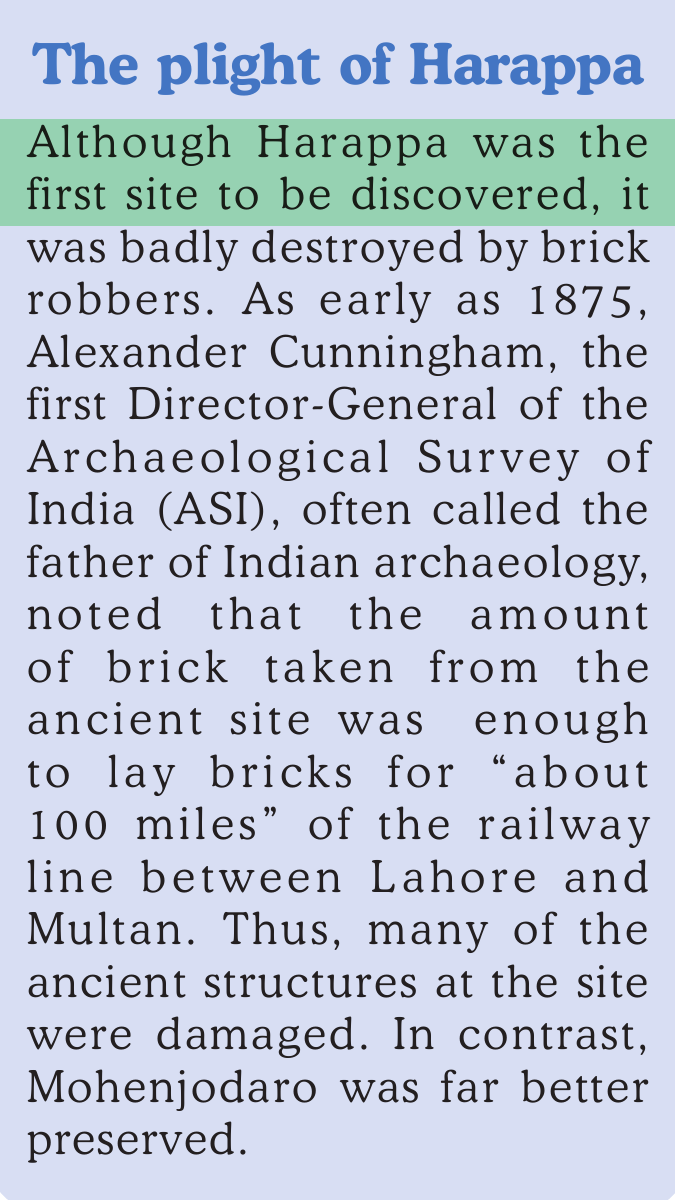
Perhaps the most unique feature of the Harappan civilisation was the development of urban centres. Let us look at one such centre, Mohenjodaro, more closely. Although Mohenjodaro is the most well-known site, the first site to be discovered was Harappa. The settlement is divided into two sections, one smaller but higher and the other much larger but lower. Archaeologists designate these as the Citadel and the Lower Town respectively. The Citadel owes its height to the fact that buildings were constructed on mud brick platforms. It was walled, which meant that it was physically separated from the Lower Town. The Lower Town was also walled. Several buildings were built on platforms, which served as foundations. It has been calculated that if one labourer moved roughly a cubic metre of earth daily, just to put the foundations in place it would have required four million person-days, in other words, mobilising labour on a very large scale. Consider something else. Once the platforms were in place, all building activity within the city was restricted to a fixed area on the platforms. So it seems that the settlement was first planned and then implemented accordingly. Other signs of planning include bricks, which, whether sun-dried or baked, were of a standardised ratio, where the length and breadth were four times and twice the height respectively. Such bricks were used at all Harappan settlements. Although Harappa was the first site to be discovered, it was badly destroyed by brick robbers. As early as 1875, Alexander Cunningham, the first Director-General of the Archaeological Survey of India (ASI), noted that the amount of brick taken from the ancient site was enough to lay bricks for “about 100 miles” of the railway line between Lahore and Multan.

Which was the first site to be discovered?

Answer & explanation+

Correct answer: option 2

The correct answer is Option (2) → Harappa

Mohenjodaro is the best-known Harappan site, but the first site to be discovered was Harappa, and the whole civilisation is named after it. Harappa was badly damaged by brick robbers: as early as 1875, Alexander Cunningham noted that bricks taken from the site were enough to lay about 100 miles of the railway line between Lahore and Multan. Mohenjodaro, in contrast, was far better preserved.

Note: A same/similar question was asked in CUET (UG) in the papers below.

20262025202420232022
13-05 S1
21-05 S1
–19-07 S1*––

* A similar question.


NCERT (2025-26): “3. Mohanjodaro A Planned Urban Centre … Perhaps the most unique feature of the Harappan civilisation was the development of urban centres. Let us look at one such centre, Mohenjodaro, more closely. Although Mohenjodaro is the most well-known site, the first site to be discovered was Harappa.…”

NCERT extract

Advertisement

Practise more on Ancient India: Bricks, Beads and Bones

Chapter-wise mocks on the real NTA exam screen, with solutions and your rank. Your first mocks are free.

Start free mocks →

Advertisement

Next questions

  1. Anu and Shikha are partners sharing profits and losses in the ratio of 3:2. Their capital accounts showed balances of Rs. 1,50,000 and Rs.…Accountancy Part A · Accounting for Partnership
  2. In __________ the client is taught to contract individual muscle groups in order to give the awareness of tenseness or muscular tension.Psychology · Therapeutic Approaches
  3. Which of the following structures is not found in the Citadel?History · Ancient India: Bricks, Beads and Bones
  4. Identify the incorrect statements among the following.A. The displacement current flows in a dielectric of capacitor when the potential dif…Physics · Electromagnetic Waves
  5. What was the important difference between Johnson & Johnson and most other companies?Business Studies · Organising
  6. The ratio in which the continuing partners have acquired the share from the retiring/deceased partner is called the:Accountancy Part A · Reconstitution of Partnership Firm: Retirement and Death
  7. Colour therapy is still not accepted as a form of treatment by majority of western medical fraternity asEnglish · Comprehension - (Narrative / Factual)
  8. If A is a square matrix of order 3 such that A(adj\ A)= […] , then |adj\ A| is equal toMaths. Section A · Determinants
  9. Which of the following is NOT the reason for rural-urban migration in our country?Geography · India-People and Economy: Geographical Perspective on selected issues and Problems
  10. Choose the correct water-image of the Fig. (X) from amongst the four alternatives given:General Aptitude Test · Non-Verbal Reasoning