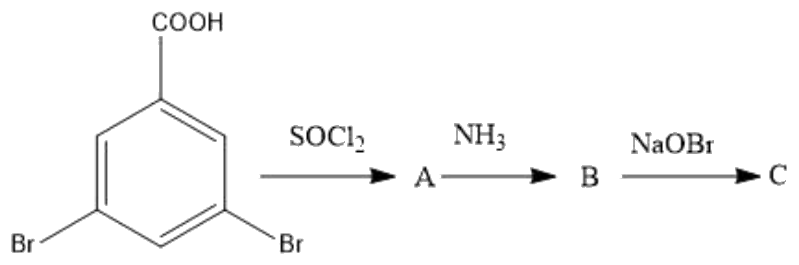
Identify the product C
Answer & explanation
Correct answer: option 2
The correct answer is Option (2) → 3,5-dibromoaniline
This is a three-step conversion of a carboxylic acid into an amine with one carbon atom less:
SOCl2 converts –COOH into the acid chloride –COCl (with \( \ce{SO2} \) and HCl as gases).
NH3 converts the acid chloride into the amide –\( \ce{CONH2} \).
NaOBr (\( \ce{Br2} \) + NaOH) carries out the Hofmann bromamide degradation: the aryl group migrates from the carbonyl carbon to nitrogen, the C=O carbon is lost as carbonate, and a primary amine with one carbon fewer is formed.
\( \displaystyle \ce{ArCOOH + SOCl2 -> ArCOCl + SO2 ^ + HCl ^} \)
\( \displaystyle \ce{ArCOCl + 2NH3 -> ArCONH2 + NH4Cl} \)
\( \displaystyle \ce{ArCONH2 + Br2 + 4NaOH -> ArNH2 + Na2CO3 + 2NaBr + 2H2O} \)
Here Ar = 3,5-dibromophenyl. The two Br atoms are not touched, so:
A = 3,5-dibromobenzoyl chloride
B = 3,5-dibromobenzamide
C = 3,5-dibromoaniline (\( \ce{NH2} \) in place of the COOH, meta to both Br atoms), which is structure 2.
Why the other options are incorrect
Option (1) 3,5-dibromobenzamide — Incorrect. This is intermediate B; NaOBr converts it further into the amine.
Option (3) 1,3,5-tribromobenzene — Incorrect. The Hofmann reaction puts an \( \ce{NH2} \) group, not a Br atom, in place of the carbonyl group.
Option (4) 3-amino-5-bromobenzoic acid — Incorrect. The COOH carbon is the one lost in the Hofmann step, and the ring bromines are not replaced; this structure keeps the COOH and loses a Br.
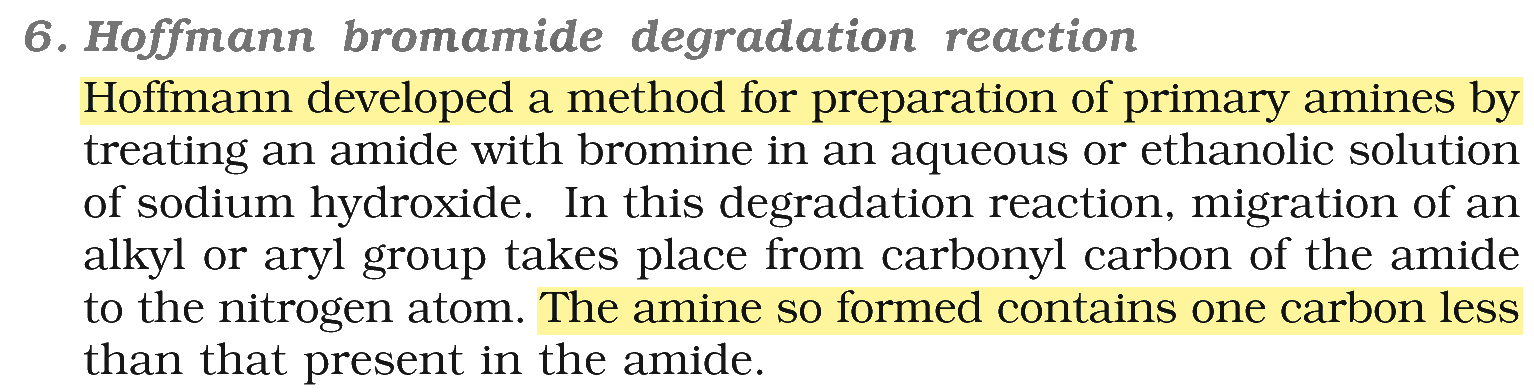
NCERT (2026-27 edition):
Hoffmann Bromamide Degradation Reaction