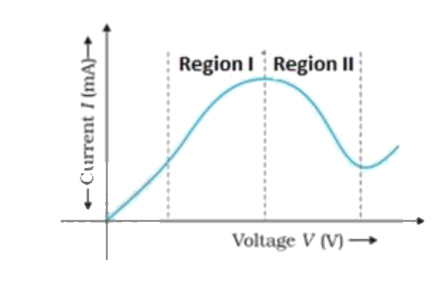
The graph for variation of current with voltage for a given material is given below. Choose the correct statements from the following:
A. The graph is for GaAs.
B. In Region II, the Ohm's law is obeyed.
C. In region II, the resistance of material is negative.
D. The material is Ohmic.
Choose the correct answer from the options given below:
Answer & explanation
Correct answer: option 3
The correct answer is Option (3) → A and C only
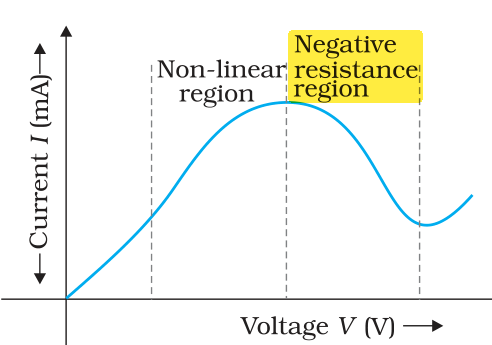
The graph is the current–voltage characteristic of gallium arsenide (GaAs): the current rises with voltage, reaches a maximum, and then falls even though the voltage keeps increasing (Region II), before rising again. A material obeys Ohm’s law only if its I–V graph is a straight line through the origin.
(A) The graph is for GaAs. — Correct. A falling current over a range of increasing voltage is the characteristic behaviour of GaAs.
(B) In Region II, the Ohm’s law is obeyed. — Incorrect. In Region II the current decreases as the voltage increases, so I is not proportional to V.
(C) In region II, the resistance of material is negative. — Correct. Here resistance means the dynamic resistance ΔV/ΔI; in Region II the voltage increases while the current decreases, so it is negative.
\( \displaystyle r = \frac{\Delta V}{\Delta I} \lt 0 \quad (\Delta V \gt 0,\ \Delta I \lt 0) \)
(D) The material is Ohmic. — Incorrect. The graph is curved and even has a falling part, so the material is non-ohmic.
NCERT (2026-27):
Limitations of Ohm’s Law – “… (c) The relation between V and I is not unique, i.e., there is more than one value of V for the same current I (Fig. 3.7). A material exhibiting such behaviour is GaAs. Materials and devices not obeying Ohm’s law in the form of Eq. (3.3) are actually widely used in electronic circuits.”