Employment in India
Read the passage carefully and answer the following questions:
Worker population ratio is an indicator which is used for analysing the employment situation in the country. The ratio is useful in knowing the proportion of population that is actively contributing to the production of goods and services of a country. There has been a change in the structure of workforce in India. Newly emerging jobs are found mostly in the service sector. The expansion of the service sector and the advent of high technology now frequently permit a highly competitive existence for efficient small scale and often individual enterprises or specialist workers side by side with the multinationals. Outsourcing of work is becoming a common practice. It means that a big firm finds it profitable to close down some of its specialist departments and hand over a large number of small piecemeal jobs to very small enterprises or specialist individuals, sometimes situated even in other countries. The traditional notion of the modern factory or office, as a result, has been altered in such a manner that for many the home is becoming the workplace. All of this change has not gone in favour of the individual worker. The nature of employment has become more informal with only limited availability of social security measures to the workers. In the last few decades, there has been rapid growth in the gross domestic product, but without simultaneous increase in employment opportunities. This has forced the government to take up initiatives in generating employment opportunities particularly in the rural areas as it is seen in rural economy that dependency in absolute term is increasing on farm sector.
All the working persons engaged in economic activities can be classified into:
Answer & explanation
Correct answer: option 4
The correct answer is Option (4) → Primary sector, Secondary sector, Tertiary sector.
All economic activities fall into three groups by what they produce. Work directly with nature, on farms or in mines, is the primary sector; turning materials into goods or building things is the secondary sector; providing services is the tertiary sector. The eight industrial divisions are grouped in this way:
Primary sector: agriculture, and mining and quarrying
Secondary sector: manufacturing; electricity, gas and water supply; and construction
Tertiary or service sector: trade; transport and storage; and services
The other options mix a sector with one of its own parts: agriculture is part of the primary sector, and manufacturing is part of the secondary sector.
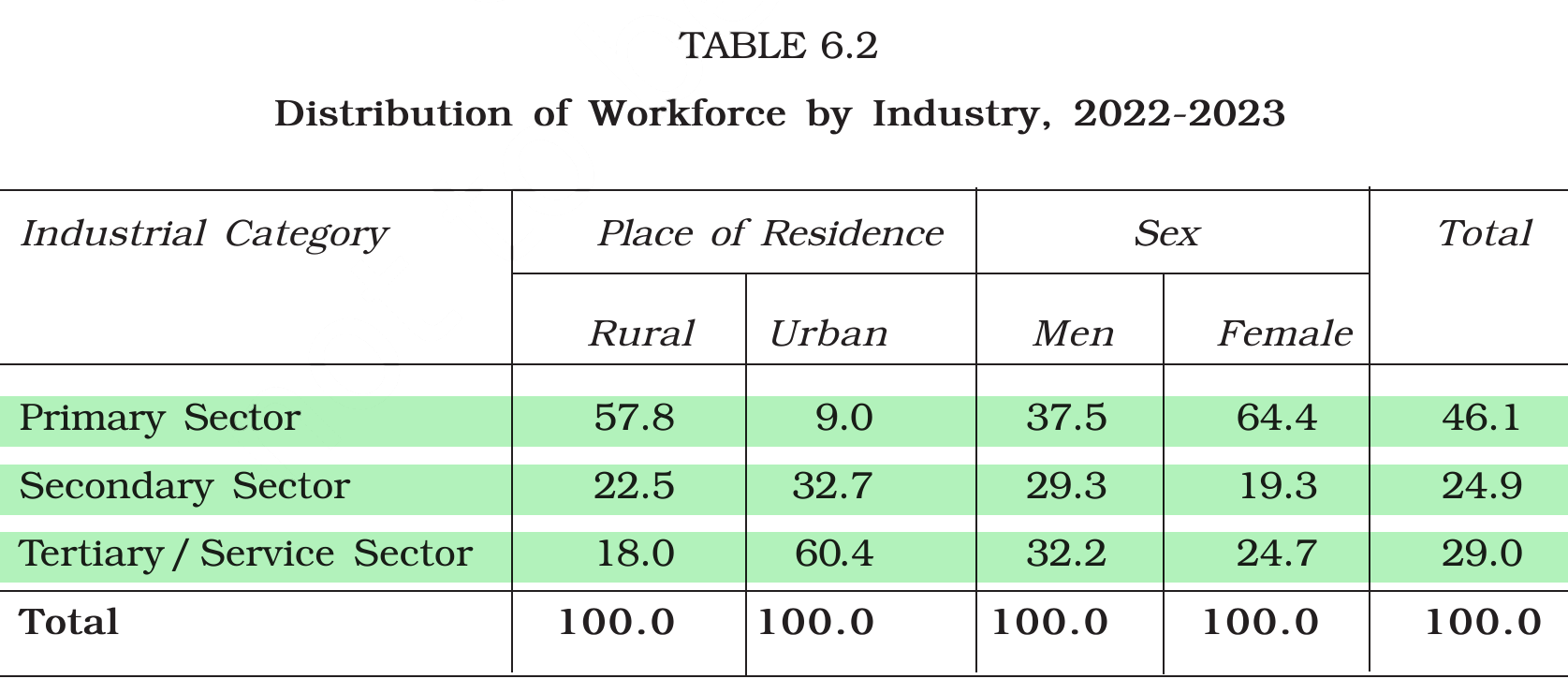
NCERT (2025-26): “6.5 Employment in Firms, Factories and Offices … Generally, we divide all economic activities into eight different industrial divisions. They are (i) Agriculture (ii) Mining and Quarrying (iii) Manufacturing (iv) Electricity, Gas and Water Supply (v) Construction (vi) Trade (vii) Transport and Storage and (viii) Services. For simplicity, all the working persons engaged in these divisions can be clubbed into three major sectors viz., (a) primary sector which includes (i) and (ii), (b) secondary sector which includes (iii), (iv) and (v) and (c) service sector which includes divisions (vi), (vii) and (viii). Table 6.2 shows the distribution of working persons in different industries during the year 2022-23.…”
|