Carbonyl Compounds
2,4-dinitrophenylhydrazine (2,4-DNP) which is also known as Brady’s reagent is used to identify the presence of carbonyl group in aliphatic as well as aromatic compounds. A solution of 2,4-DNP in sulphuric acid is added to the alcoholic solution of an organic compound (A) with molecular formula C4H8O. An orange-red precipitate is obtained. On warming Compound A with freshly prepared ammoniacal silver nitrate solution, a bright silver mirror is produced due to the formation of silver metal. Compound A is easily oxidised to carboxylic acid B with molecular formula C4H8O2 on treatment with common oxidising agents like nitric acid, potassium permanganate, potassium dichromate, etc. A on catalytic hydrogenation give a straight chain alcohol. Two moles of compound A in the presence of dilute alkali form a β-hydroxy aldehyde C which readily loses water to give α,β-unsaturated carbonyl compound D.
The α,β-unsaturated carbonyl compound formed by the dehydration of compound C is:
Answer & explanation
Correct answer: option 1
The correct answer is Option (1) → 2-ethylhex-2-enal
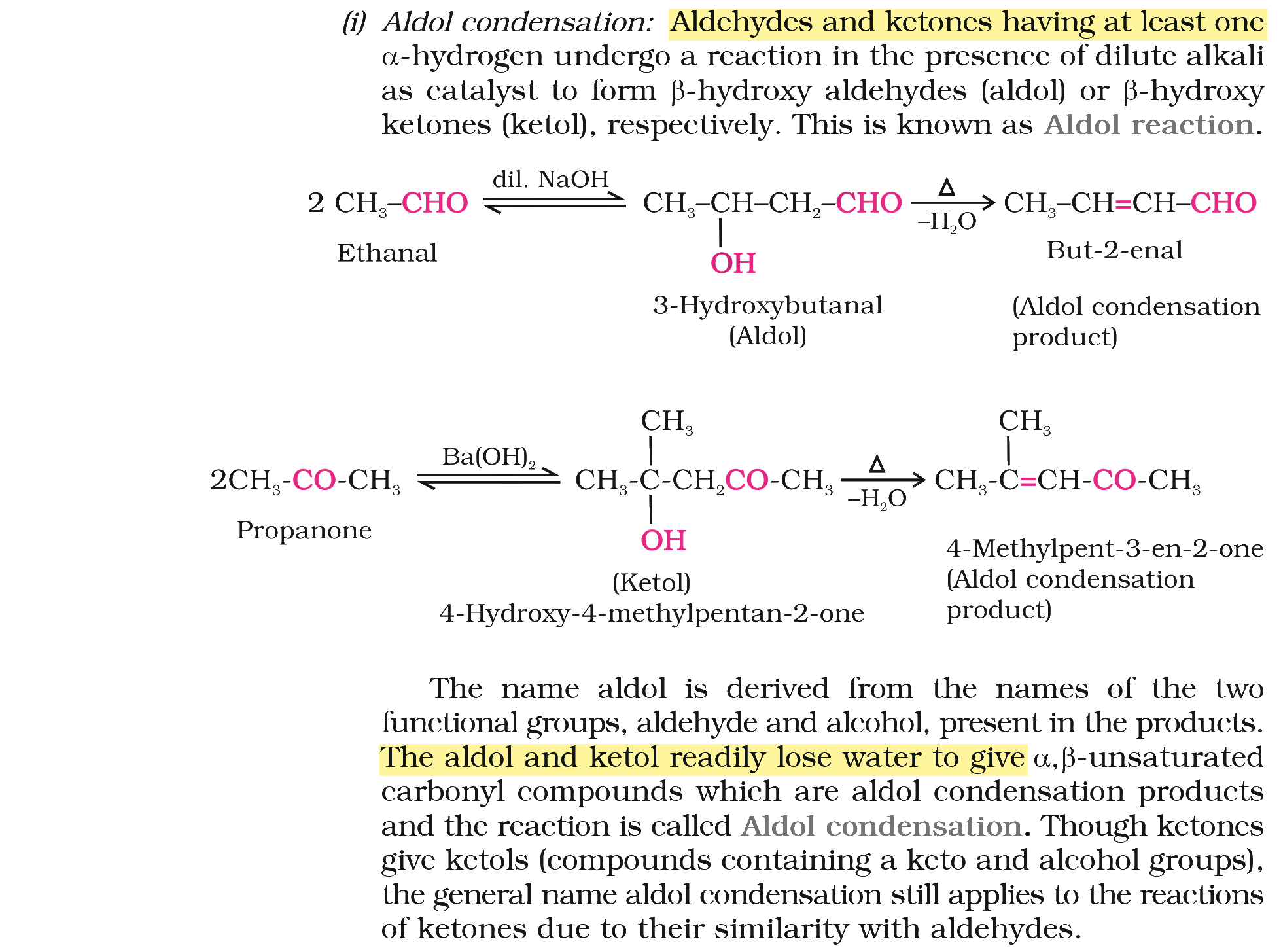
Aldehydes and ketones that have at least one α-hydrogen undergo the aldol reaction with dilute alkali. The α-carbon of one molecule bonds to the carbonyl carbon of another, giving a β-hydroxy aldehyde (aldol). On heating, the aldol loses water between the α-carbon and the β-carbon, giving an α,β-unsaturated aldehyde.
From the passage, compound A is butanal, \( \ce{CH3CH2CH2CHO} \) (\( \ce{C4H8O} \), a straight-chain aldehyde). Its α-carbon carries an ethyl group, so the new C–C bond places an ethyl branch next to the CHO group:
\( \displaystyle \ce{2CH3CH2CH2CHO} \xrightarrow{\text{dil. NaOH}} \ce{CH3CH2CH2-CH(OH)-CH(C2H5)-CHO} \)
\( \displaystyle \ce{CH3CH2CH2-CH(OH)-CH(C2H5)-CHO} \xrightarrow[-\ce{H2O}]{\text{Heat}} \ce{CH3CH2CH2-CH=C(C2H5)-CHO} \)
The C=C bond forms between C-2 (the α-carbon, bearing the ethyl group) and C-3 (the β-carbon), in conjugation with the CHO group. So compound D is 2-ethylhex-2-enal, the structure in Option (1).
Why the other options are incorrect
Option (2) 2-ethylhex-3-enal — Incorrect. The double bond is between C-3 and C-4, so it is not conjugated with the carbonyl group. Dehydration of an aldol removes OH from the β-carbon and H from the α-carbon, so C=C must start at C-2.
Option (3) 2-ethylidenehexanal — Incorrect. It is α,β-unsaturated, but its carbon skeleton is wrong: it has a butyl chain and an ethylidene group, while the aldol of butanal has a propyl chain on the β-carbon and an ethyl group on the α-carbon.
Option (4) 2-ethylhex-5-enal — Incorrect. The double bond is at the end of the chain, far from the CHO group, so it is not an α,β-unsaturated carbonyl compound.
NCERT (2026-27 edition):
Aldol Condensation