CUETMOCK
  • Pricing
  • Mentors
Log inStart freeStart free mocks→

First test, then trust

Try a free CUET mock test.

Join 5,00,000+ students who rehearsed exam day on the exact NTA screen before sitting CUET. On the web and on Android.

Start free mocks →Get the Android app
CUETMOCK

India's #1 CUET Mock Test Platform. Original NCERT-based questions on the exact NTA exam screen — trusted by 5,00,000+ students since CUET 2022.

Get it onGoogle PlayScan to download the CUETMOCK app

Mock tests

  • CUET mock test series
  • Commerce mocks
  • Humanities (Arts) mocks
  • Science mocks
  • Languages & GAT mocks
  • Free practice questions
  • Pricing

Resources

  • CUET exam guide
  • CUET syllabus
  • Universities accepting CUET
  • Expert blogs
  • News & notifications
  • Webinars & counselling
  • CUET score calculator
  • How we estimate your rank
  • FAQs

Company

  • About us
  • Our leadership & team
  • Our toppers
  • Mentors
  • For schools
  • Contact us
  • Terms
  • Privacy
  • Refund policy

Talk to us

+91 7696 6630 56info@cuetmock.comWhatsApp us

Our other platforms

  • JEE Mock — For IIT-JEE aspirants
  • NEET Mock — For NEET aspirants

Newsletter

Exam updates, study material and offers — no spam.

© 2026 NYC Ventures Pvt. Ltd.

701-702, Royal Business Park, Zirakpur, Punjab - 140603

  • Terms of use
  • Privacy policy
  • Refund policy
  • Contact us

iCUETMOCK is an independent preparation platform, not affiliated with the National Testing Agency (NTA). Always check exam details on the official NTA website.

  • Home
  • Mock tests
  • CUET guide
  • Pricing
  • Log in
Home/Practice questions/History
HistoryMedieval India: Bhakti Sufi Traditions

Who coined the term “Great” and “little” traditions in the twentieth-…

Who coined the term “Great” and “little” traditions in the twentieth-century?

Answer & explanation+

Correct answer: option 4

The correct answer is Option (4) → Robert Redfield

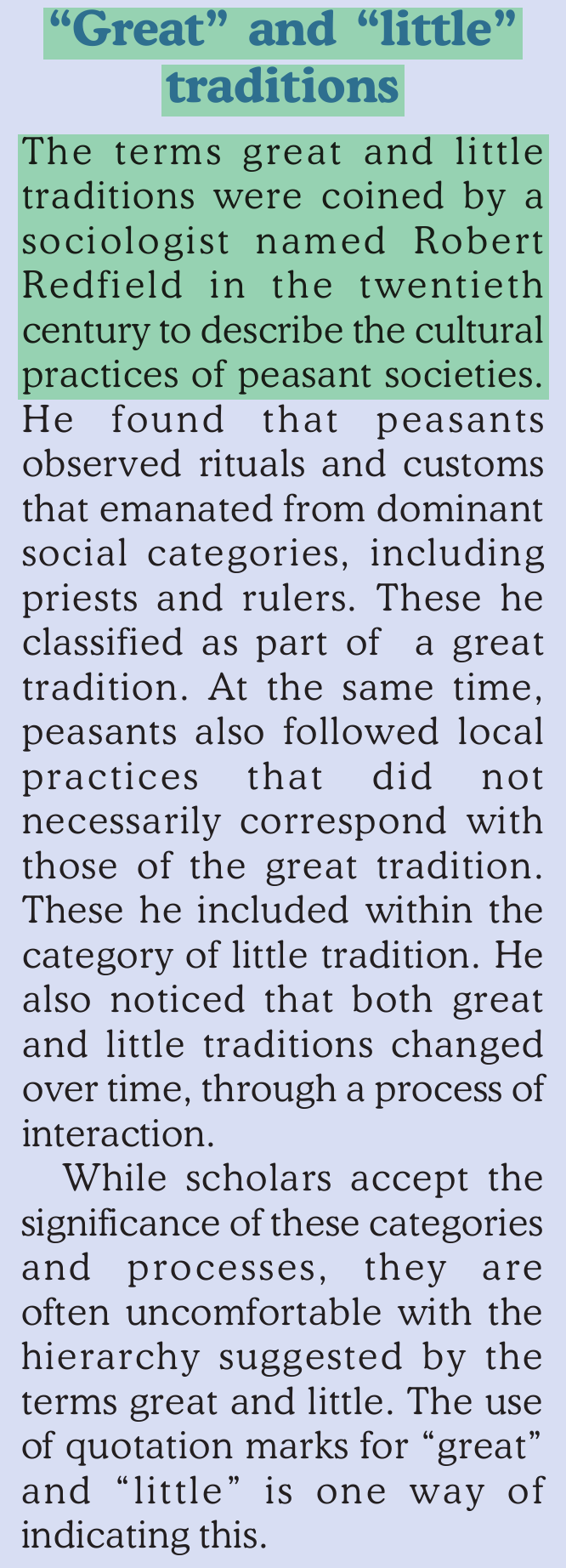
The sociologist Robert Redfield used the terms in the twentieth century to describe the culture of peasant societies. He saw that peasants followed rituals and customs that came from the dominant groups, such as priests and rulers. He called these the great tradition. Peasants also followed local practices that did not always match the great tradition. He called these the little tradition. Both kinds of tradition changed over time as they acted on each other.

Note: A same/similar question was asked in CUET (UG) in the papers below.

20262025202420232022
11-05 S1*
21-05 S1
19-05 S1*
23-05 S1*
–30-05 S1*–

* A similar question.


NCERT: Themes in Indian History Part II — Chapter 6: Bhakti-Sufi Traditions (2025-26)

NCERT extract

Advertisement

Practise more on Medieval India: Bhakti Sufi Traditions

Chapter-wise mocks on the real NTA exam screen, with solutions and your rank. Your first mocks are free.

Start free mocks →

Advertisement

Next questions

  1. A, P, R, X, S and Z are sitting in a row. S and Z are in the centre, and A and P are at the ends. R is sitting on the left of A. Then who i…General Aptitude Test · Verbal Reasoning
  2. Soni, Moni and Toni are partners sharing profits in the ratio of 5:3:2. If Moni's share of profit at the end of the year amounted to Rs.1,5…Accountancy Part A · Accounting for Partnership
  3. When a p-n junction diode is reverse biased,(A) the height of the potential barrier decreases.(B) the height of the potential barrier incre…Physics · Semiconductors and Electronic Devices
  4. Which one of the following statements is correct about the Planning Commission?Political Science · Politics in India Since Independence: Politics of Planned Development
  5. Arrange the following countries in descending order of population.A. NigeriaB. U.S.A.C. MexicoD. IndonesiaChoose the correct answer from th…Geography · Fundamentals of Human Geography: World Population-Distribution, Density and growth
  6. In the village community of the Mughal-society, the term “mandal” stood for __________.History · Medieval India: Peasants, Zamindars and the State
  7. What was not the major factor that accounted for the constant expansion of agriculture during sixteenth and seventeenth-centuries in India?History · Medieval India: Peasants, Zamindars and the State
  8. When was the first population census conducted in India?Geography · India-People and Economy: Population-Distribution,Density, Growth and Composition
  9. The α,β-unsaturated carbonyl compound formed by the dehydration of compound C is:Chemistry · Organic: Aldehydes, Ketones and Carboxylic Acids
  10. In the word PACHYDERM, derm means--English · Comprehension - (Narrative / Factual)