Which of the following compound will react with NaOI to form a yellow precipitate with a characteristic smell?
Answer & explanation
Correct answer: option 2
The correct answer is Option (2) → 1-phenylethanol
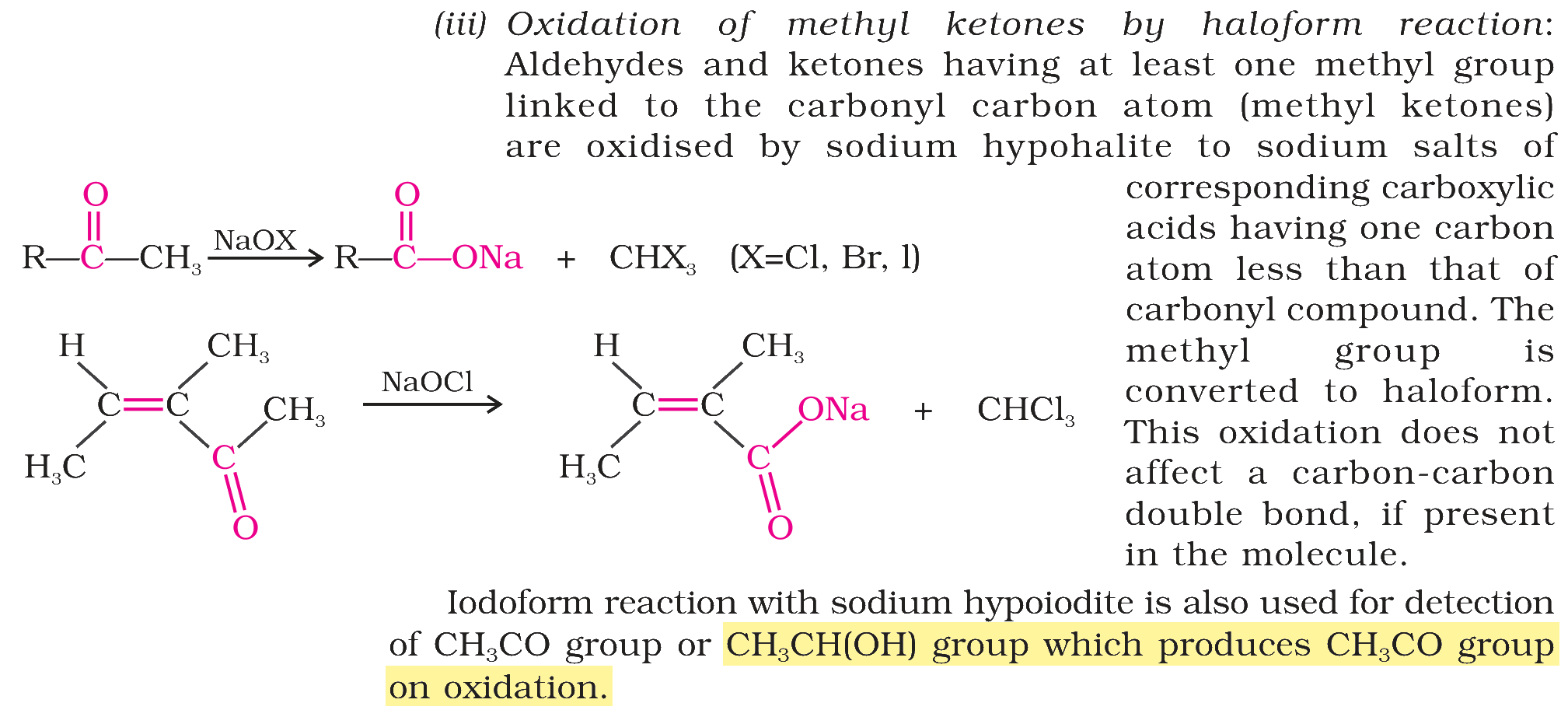
The yellow precipitate with a characteristic smell is iodoform (CHI3). Sodium hypoiodite (NaOI, from \( \ce{I2} \) + NaOH) gives this iodoform test with compounds containing:
a CH3CO– group (methyl ketones and acetaldehyde), or
a CH3CH(OH)– group (ethanol and secondary alcohols of this type), because NaOI first oxidises it to \( \ce{CH3CO} \)–.
The \( \ce{CH3} \) group must be on the same carbon that carries the –OH (or C=O). Only structure 2, 1-phenylethanol \( \ce{C6H5CH(OH)CH3} \), has this arrangement:
NaOI first oxidises the alcohol to the methyl ketone acetophenone; then the three H atoms of its \( \ce{CH3} \) group are replaced by iodine and the \( \ce{CI3} \) group splits off as yellow iodoform (equations written with \( \ce{I2} \) + NaOH, which give NaOI):
\( \displaystyle \ce{C6H5CH(OH)CH3 + I2 + 2NaOH -> C6H5COCH3 + 2NaI + 2H2O} \)
\( \displaystyle \ce{C6H5COCH3 + 3I2 + 4NaOH -> C6H5COONa + CHI3 v + 3NaI + 3H2O} \)
Why the other options are incorrect
Option (1) 4-methylbenzyl alcohol — Incorrect. It is a primary alcohol, \( \ce{ArCH2OH} \); its methyl group is on the ring, not on the carbon carrying –OH.
Option (3) 2-phenylethanol — Incorrect. \( \ce{C6H5CH2CH2OH} \) is a primary alcohol with no \( \ce{CH3CH(OH)} \)– group.
Option (4) (2,4-dimethylphenyl)methanol — Incorrect. It is again \( \ce{ArCH2OH} \); both methyl groups are on the ring, so there is no \( \ce{CH3CH(OH)} \)– unit.
NCERT (2026-27 edition):
Oxidation of Methyl Ketones by Haloform Reaction