Aldol Condensation
Aldehydes and ketones undergo a number of reactions due to the acidic nature of α-hydrogen. Aldehydes and ketones having at least one α-hydrogen undergo a reaction in the presence of dilute alkali as catalyst to form β-hydroxy aldehydes or β-hydroxy ketones, respectively. This is known as aldol reaction. The aldol and ketol readily lose water to give α, β-unsaturated carbonyl compounds, which are aldol condensation products; the reaction is called aldol condensation. When aldol condensation is carried out between two different aldehydes and/or ketones, it is called cross aldol condensation. Ethanal and propanal undergo this reaction to form mixture of products. However, benzaldehyde and acetophenone react to give only one product . Moreover, aldehydes which do not have an α-hydrogen atom, undergo self oxidation and reduction ( disproportionation) reaction on heating with concentrated alkali. The reaction is known as Cannizzaro reaction. In this reaction, one molecule of the aldehyde is reduced to alcohol while another is oxidised to carboxylic acid salt.
What is the reason for the acidic nature of α-hydrogen?
Answer & explanation
Correct answer: option 2
The correct answer is Option (2) → Electron-withdrawing effect of the carbonyl group.
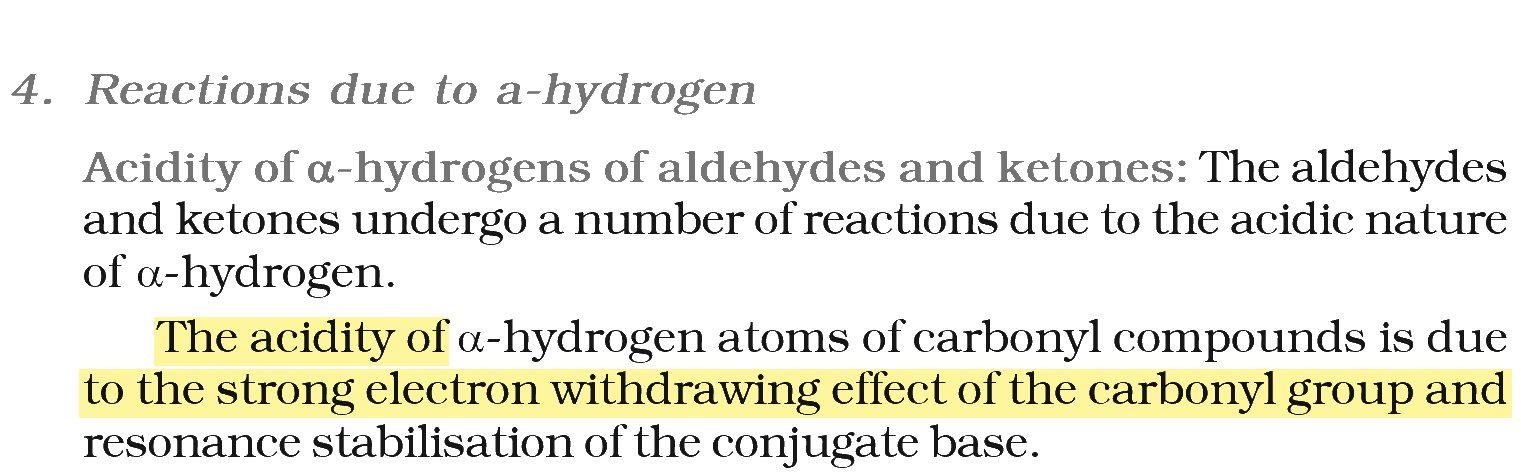
A hydrogen atom on the carbon next to the C=O group (the α-hydrogen) is much more acidic than an ordinary C–H hydrogen. Two effects of the carbonyl group act together:
Electron-withdrawing effect: the C=O group is strongly polar and pulls electron density away from the α-carbon, which weakens the C–H bond so the proton is lost more easily.
Resonance stabilisation of the conjugate base: the carbanion formed after the proton is lost is stabilised by resonance, because the negative charge is shared with the electronegative oxygen atom (enolate ion).
\( \displaystyle \ce{CH3-CHO + OH^- <=> [CH2-CHO]^- + H2O} \)
So the acidic nature of α-hydrogen is due to the electron-withdrawing effect of the carbonyl group.
Why the other options are incorrect
Option (1) Electron-releasing effect of carbonyl group. — Incorrect. The carbonyl group withdraws electrons; an electron-releasing group would make the hydrogen less acidic.
Option (3) Resonance stabilization of carbonyl group — Incorrect. It is the carbanion (enolate ion) formed after losing the proton that is resonance stabilised, not the carbonyl group itself.
Option (4) sp2 hybridisation of carbonyl carbon — Incorrect. The α-hydrogen is on the sp3 α-carbon, and the hybridisation of the carbonyl carbon does not by itself explain the acidity.
NCERT (2026-27 edition):
Reactions Due to α-Hydrogen