The reagent which does not generate haloalkane when heated with alcohol:
Answer & explanation
Correct answer: option 3
The correct answer is Option (3) → Ethyl magnesium bromide
An alcohol is converted into a haloalkane by replacing its –OH group with a halogen. The usual reagents are concentrated halogen acids and phosphorus or thionyl halides.
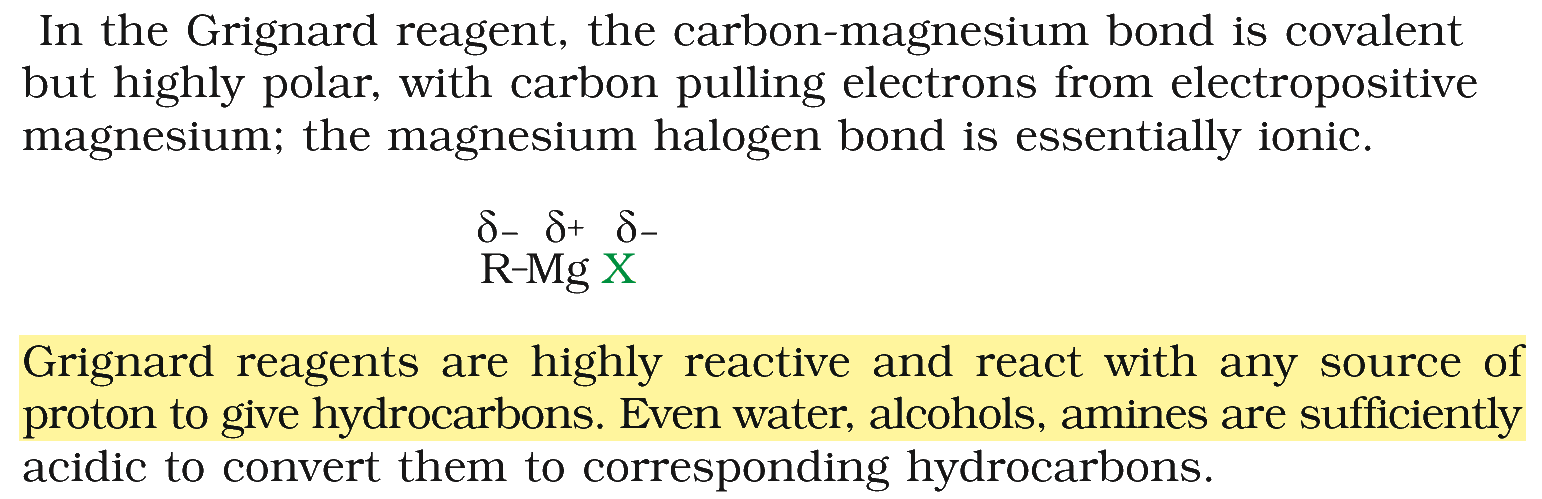
A Grignard reagent does something quite different. The C–Mg bond is strongly polar, so the alkyl group behaves as a very strong base. It removes the acidic hydrogen of the –OH group and becomes an alkane:
\( \displaystyle \ce{C2H5MgBr + ROH -> C2H6 + Mg(OR)Br} \)
Option (1) Phosphorus tribromide — Generates a haloalkane. Each \( \ce{PBr3} \) converts three molecules of alcohol into bromoalkane.
\( \displaystyle \ce{3ROH + PBr3 -> 3RBr + H3PO3} \)
Option (2) Thionyl chloride — Generates a haloalkane. It gives the chloroalkane, and both by-products are gases that escape, so the product is easy to obtain pure.
\( \displaystyle \ce{ROH + SOCl2 -> RCl + SO2 ^ + HCl ^} \)
Option (3) Ethyl magnesium bromide — Does not generate a haloalkane. The Grignard reagent takes the acidic hydrogen of the alcohol and gives ethane.
Option (4) Red Phosphorus/ Bromine — Generates a haloalkane. Red phosphorus and bromine form \( \ce{PBr3} \) in the reaction mixture, which then converts the alcohol into the bromoalkane.
\( \displaystyle \ce{2P + 3Br2 -> 2PBr3} \)
\( \displaystyle \ce{3ROH + PBr3 -> 3RBr + H3PO3} \)
NCERT (2026-27 edition):
Reactions of Haloalkanes – …