
Alkyl halide
The reactivity of alkyl halides is influenced by their chemical structure and the reaction conditions, leading to different mechanistic pathways. A chemist was studying the hydrolysis of the different bromo-alkanes (P) CH3Br (Q) (CH3)2CHBr and (R) (CH3)3C-Br. When reacted at a low concentration of NaOH in aqueous acetone medium, the rate of reaction was found to be P > Q > R. However, when the same reaction was carried out with a high conc. NaOH in purely aqueous solution, the order of reactivity reversed, becoming R > Q > P. Furthermore, the hydrolysis of (R) resulted in the formation of a racemic mixture while (P) led to the inversion of configuration.
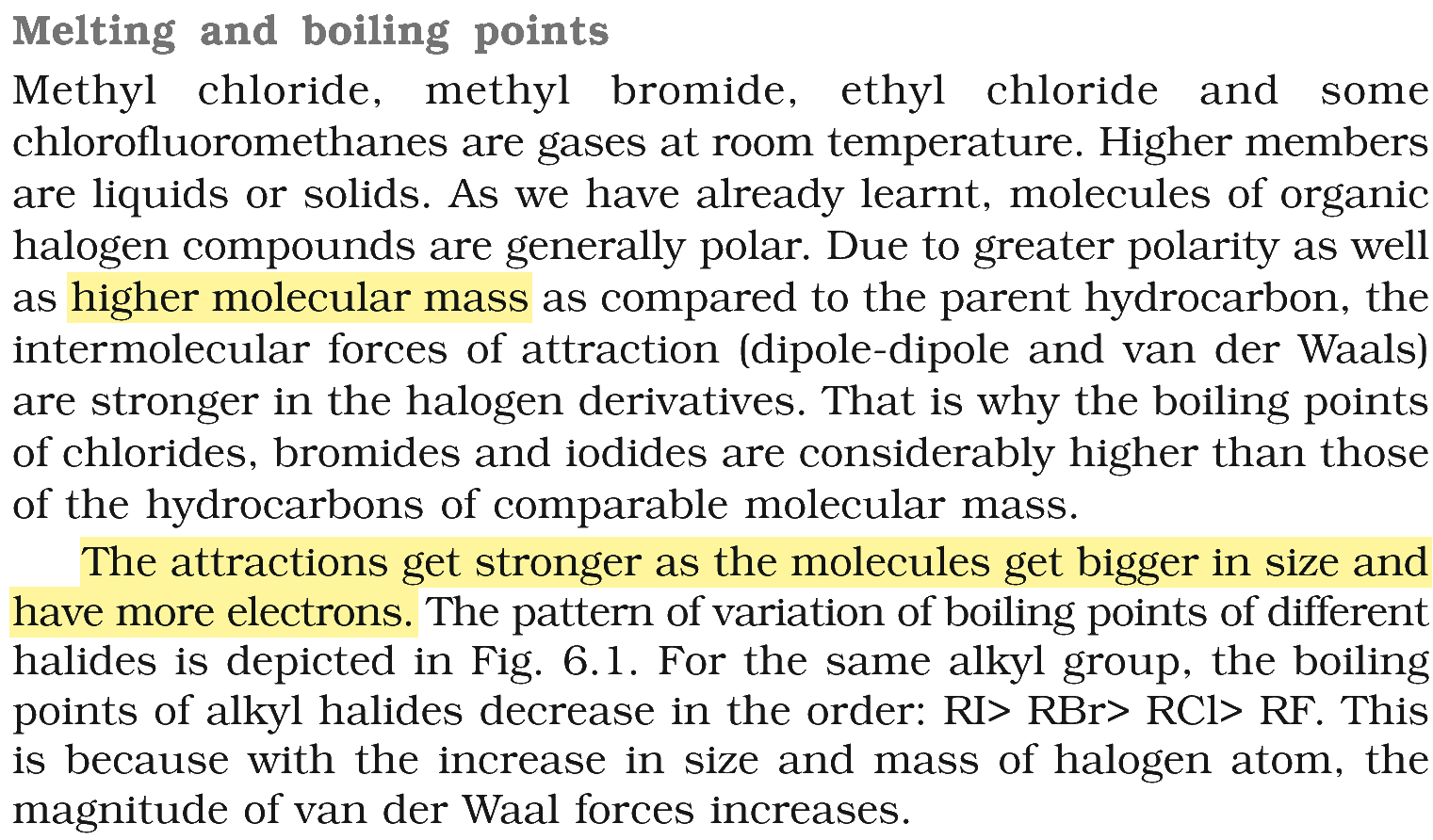
Methyl chloride, methyl bromide, ethyl chloride and some chlorofluoromethanes are gases at room temperature. Higher members are liquids or solids. Molecules of organic halogen compounds are generally polar. Due to greater polarity as well as higher molecular mass as compared to the parent hydrocarbon, the intermolecular forces of attraction (dipole-dipole and van der Waals) are stronger in the halogen derivatives. This is the reason, the boiling points of chlorides, bromides and iodides are considerably higher than those of the hydrocarbons of comparable molecular mass.
The attractions get stronger as the molecules get bigger in size and have more electrons. For the same alkyl group, the boiling points of alkyl halides decrease in the order: RI > RBr > RCl > RF. This is because with the increase in size and mass of halogen atom, the magnitude of van der Waals forces increases.
Which compound will show the highest boiling point?
Answer & explanation
Correct answer: option 2
The correct answer is Option (2) → Bromoform
The boiling point of a haloalkane rises with the strength of its van der Waals forces, which grow with molecular mass and the number of electrons. Two things increase them in halomethanes:
a heavier halogen (for the same alkyl group: RI > RBr > RCl > RF), and
more halogen atoms on the carbon.
Comparing the four compounds (molar mass and boiling point):
Chloromethane, \( \ce{CH3Cl} \): 50.5 g mol−1, 249 K
Bromomethane, \( \ce{CH3Br} \): 95 g mol−1, 277 K
Dibromomethane, \( \ce{CH2Br2} \): 174 g mol−1, 370 K
Bromoform, CHBr3: 253 g mol−1, 423 K
So bromoform, with three bromine atoms, has the highest boiling point.
Why the other options are incorrect
Option (1) Chloromethane — Incorrect. The lightest, with one chlorine atom; it is a gas at room temperature.
Option (3) Dibromomethane — Incorrect. Two bromine atoms, one fewer than bromoform, so weaker forces.
Option (4) Bromomethane — Incorrect. Only one bromine atom; it is also a gas at room temperature.
Note 1: It seems that there is a mistake in the original NTA paper, which says that the hydrolysis of (R) (CH3)3C-Br gave a racemic mixture and that (P) CH3Br showed inversion of configuration; neither compound is chiral, so neither observation can be made on them.
NCERT (2026-27 edition):
Physical Properties – …
Note 2: The same/similar question has been asked in different years by NTA as per the details given below:
| 2026 | 2025 | 2024 | 2023 | 2022 |
|---|---|---|---|---|
| 25-05 S1 14-05 S2 | – | – | – | – |