
The correct IUPAC name of the following complex compound
[Ag(NH3)2][Ag(CN)2] is:
Answer & explanation
Correct answer: option 4
The correct answer is Option (4) → Diamminesilver(I)dicyanoargentate(I)
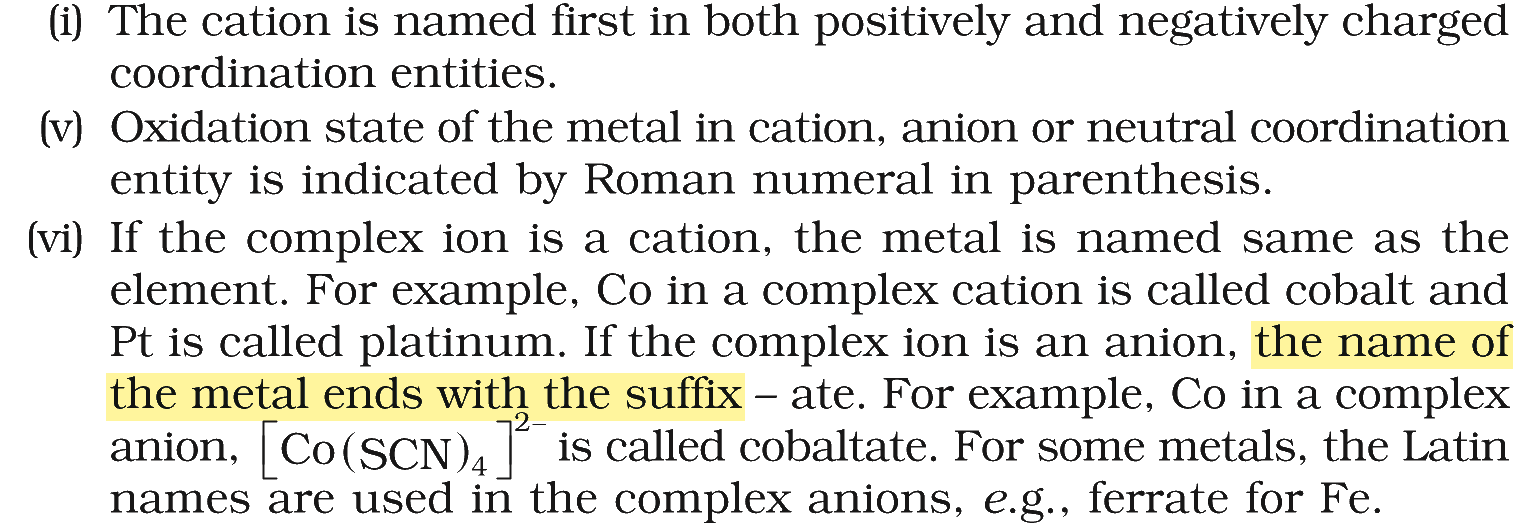
Both ions are named, cation first; the anionic silver takes the “-ate” name, argentate.
Find the oxidation state of silver in each ion:
\( \displaystyle [\mathrm{Ag(NH_3)_2}]^{+}:\ x+2(0)=+1\ \Rightarrow\ x=+1 \)
\( \displaystyle [\mathrm{Ag(CN)_2}]^{-}:\ x+2(-1)=-1\ \Rightarrow\ x=+1 \)
So the cation is diamminesilver(I) and the anion is dicyanidoargentate(I), and the name is diamminesilver(I) dicyanidoargentate(I). Option (4) writes the anion with the older ligand name cyano, dicyanoargentate(I); both names mean the same ion.
Why the other options are incorrect
Option (1) Diamminedicyanidoargentate(I) — Incorrect. This names a single complex with all four ligands on one silver atom. The compound actually has two separate complex ions, each with its own silver atom.
Option (2) Diamminedicyanidosilver(I) — Incorrect. This also treats the salt as one complex, and gives no name to the second silver atom.
Option (3) Dicyanidosilver(I)diammineargentate(I) — Incorrect. This names the anion first and uses “argentate” for the cation. The -ate ending belongs only to the anionic complex.
NCERT (2026-27 edition):
Naming of Mononuclear Coordination Compounds – …
Note: The same/similar question has been asked in different years by NTA as per the details given below:
| 2026 | 2025 | 2024 | 2023 | 2022 |
|---|---|---|---|---|
| 31-05 S2 15-05 S1 11-05 S1 | – | – | – | – |