Read the following passage carefully and answer the given questions.
Polymerase Chain Reaction
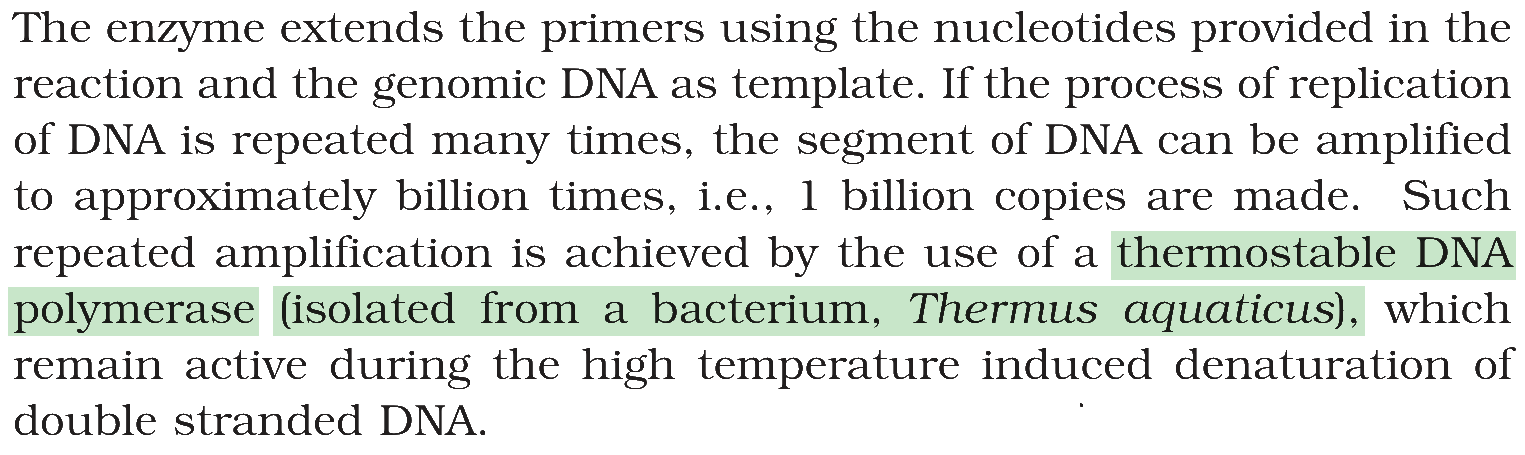
PCR stands for Polymerase Chain Reaction. In this reaction, multiple copies of the gene of interest is synthesised in vitro using two sets of primers and the enzyme DNA polymerase. The enzyme extends the primers using the nucleotides provided in the reaction and the genomic DNA as template. If the process of replication of DNA is repeated many times, the segment of DNA can be amplified to approximately billion times, i.e., 1 billion copies are made. Such repeated amplification is achieved by the use of a thermostable DNA polymerase, which remain active during the high temperature induced denaturation of double stranded DNA. The amplified fragment if desired can now be used to ligate with a vector for further cloning.
Thermostable DNA polymerase is isolated from -
Answer & explanation
Correct answer: option 3
The correct answer is Option (3) → Thermus aquaticus
PCR runs through a very high temperature in every cycle to separate the DNA strands. So it needs a thermostable DNA polymerase, one that stays active at that heat. This enzyme is isolated from the bacterium Thermus aquaticus, which lives in hot springs. The enzyme is called Taq polymerase.
(1) E. coli — Incorrect. E. coli is the common host bacterium for cloning, for example with the vector pBR322. Its enzymes do not survive the high temperature of PCR.
(2) Aspergillus niger — Incorrect. It is a fungus used to produce citric acid.
(3) Thermus aquaticus — Correct. It is the source of the thermostable DNA polymerase.
(4) Bacillus thuringiensis — Incorrect. It is a soil bacterium whose cry genes give the Bt toxin used in Bt cotton.
Note 1: This passage is taken from NCERT as it is. Most CUET (UG) questions come straight from NCERT, so study the book line by line, including figures and their titles.
Note 2: A similar question was also asked in CUET (UG) 2025 on 29-05-2025 (Slot 1), on 20-05-2025 (Slot 2) and on 16-05-2025 (Slot 1), in CUET (UG) 2024 on 29-05-2024 (Slot 1), and in CUET (UG) 2023 on 30-05-2023 (Slot 1).
NCERT Extract:
Amplification of Gene of Interest Using PCR – …