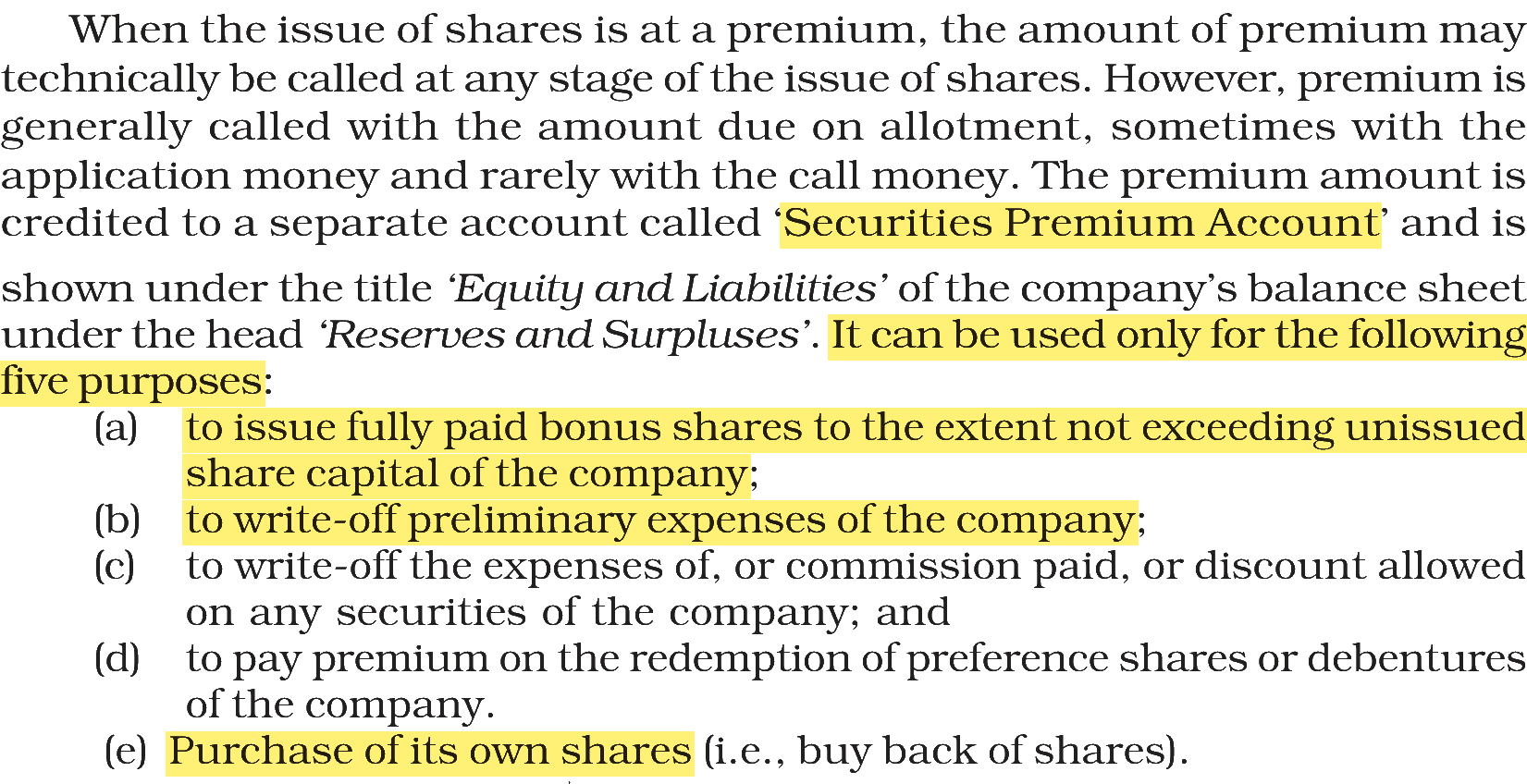
The premium amount collected from issue of shares can be used for the following purposes:
(A) To purchase own shares.
(B) To issue fully paid bonus shares to the extent not exceeding unissued share capital of the company.
(C) To write-off preliminary expenses of the company.
(D) To write-off fixed assets from books.
Choose the correct answer from the options given below:
Answer & explanation
Correct answer: option 1
The correct answer is Option (1) → (A), (B) and (C) only
The premium collected on issue of shares is kept in the Securities Premium account. It is not a free profit: it can be used only for the five purposes the law lists.
(A) To purchase own shares. Correct. A buy-back of the company’s own shares may be financed out of securities premium.
(B) To issue fully paid bonus shares to the extent not exceeding unissued share capital of the company. Correct. The premium can pay up bonus shares, as long as they stay within the unissued share capital.
(C) To write-off preliminary expenses of the company. Correct. The expenses of forming the company may be written off against the premium.
(D) To write-off fixed assets from books. Incorrect. Writing off a fixed asset is not one of the permitted purposes; a fall in an asset’s value is charged through depreciation or a loss against profits, not against securities premium.
NCERT (2026-27 edition):
|