Ethanol is dehydrated in the presence of conc.Sulphuric acid at ______ by ____ mechanism, to produce ethoxyethane as the main product.
Answer & explanation
Correct answer: option 1
The correct answer is Option (1) → 413 K by SN2
When ethanol is heated with concentrated sulphuric acid, the product depends on the temperature:
At 443 K: one molecule of ethanol loses water (elimination) and gives ethene.
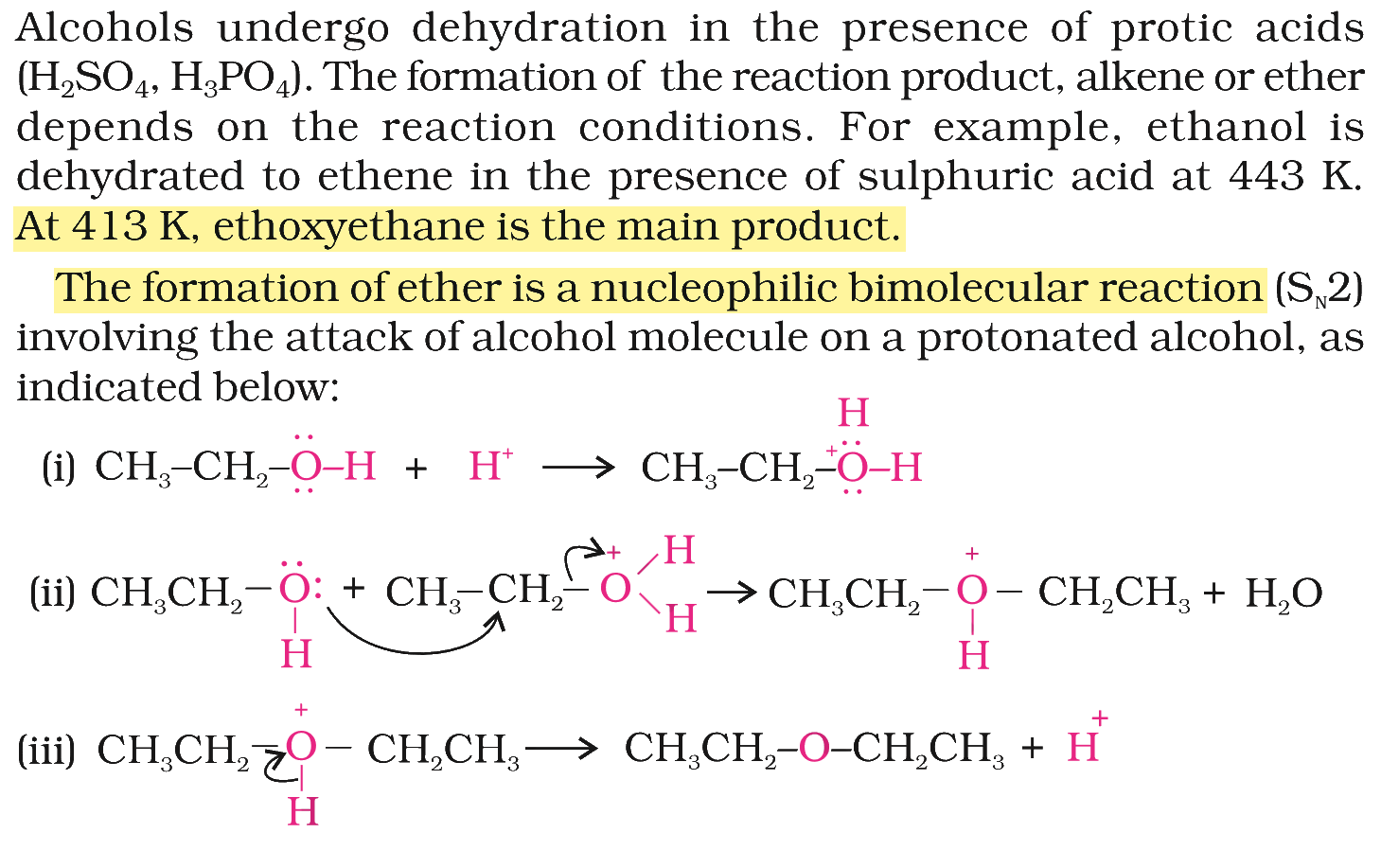
At 413 K: two molecules of ethanol lose one molecule of water between them and give ethoxyethane.
\( \displaystyle \ce{2C2H5OH} \xrightarrow[\text{413 K}]{\text{conc. }\ce{H2SO4}} \ce{C2H5-O-C2H5 + H2O} \)
\( \displaystyle \ce{C2H5OH} \xrightarrow[\text{443 K}]{\text{conc. }\ce{H2SO4}} \ce{CH2=CH2 + H2O} \)
The ether is formed by nucleophilic substitution: a second ethanol molecule attacks the protonated alcohol and water leaves in the same step.
The carbon attacked is primary, and a primary carbocation is too unstable to form on its own, so the substitution takes place in one step, that is, by the SN2 mechanism. So ethoxyethane is formed at 413 K by SN2.
Why the other options are incorrect
Option (2) 443 K by SN1 — Incorrect. At 443 K ethanol gives ethene, and an SN1 path would need an unstable primary carbocation.
Option (3) 443 K by SN2 — Incorrect. The mechanism is right, but at 443 K elimination to ethene is the main reaction.
Option (4) 413 K by SN1 — Incorrect. The temperature is right, but no free ethyl carbocation is formed; the substitution is a one-step SN2 process.
NCERT (2026-27 edition):
By Dehydration of Alcohols – …