Rate of Chemical Reaction
Chemical reactions are the simplest way to convert one substance into the other substance. The feasibility of a chemical reaction is decided by the concepts of chemical thermodynamics under a defined set of conditions. The extent of a chemical reaction is determined by the principles of chemical equilibrium. But the information that remains undisclosed is the speed or rate of a chemical reaction, path or mechanism of a chemical reaction, time taken for a reaction to attain a state of equilibrium, factors controlling the rate of reaction etc. This information pertaining to the study of a chemical reaction is very pivotal, and it helps in understanding the nature (slow or fast nature) of a chemical reaction. The kinetics of a chemical reaction can be understood with the help of average rate of reaction or a differential rate law or an integrated rate law. There are various factors on which the rate of a chemical reaction depends viz. nature of reactants, temperature, catalyst, pressure and concentration of reactants and products (rate law expression).
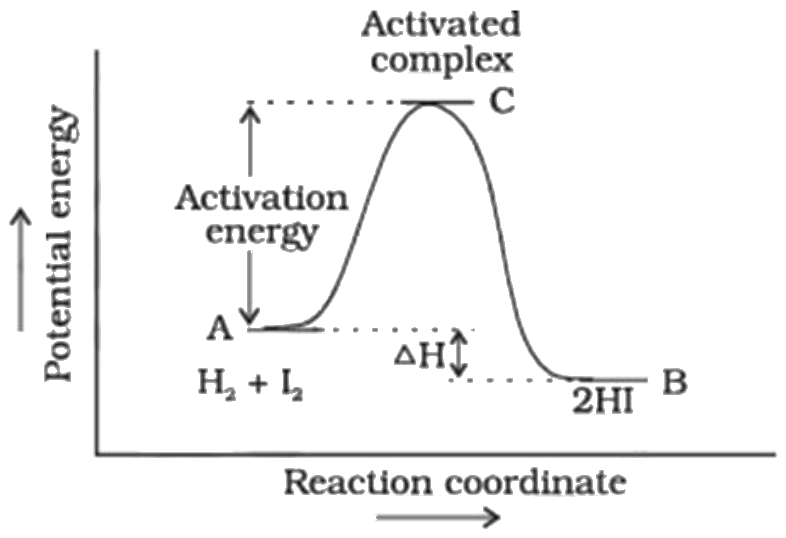
The figure given below shows a plot of potential energy vs reaction coordinate. Which of the following option is true in regard to the reaction represented by the given diagram?
Answer & explanation
Correct answer: option 1
The correct answer is Option (1) → It is an exothermic reaction involving formation of an unstable intermediate which exists for a very short time.
A potential energy diagram shows the energy of the system as reactants change into products:
The peak of the curve is the activated complex. In it, old bonds are partly broken and new bonds partly formed, so it is highly unstable and exists only for a very short time.
The activation energy is the height of the peak above the reactants.
The enthalpy change is the energy of the products minus that of the reactants:
\( \displaystyle \Delta H=H_{\text{products}}-H_{\text{reactants}} \)
If the products lie below the reactants, ΔH is negative and the reaction is exothermic. If they lie above, it is endothermic.
In the given diagram, the products (2HI, level B) lie below the reactants (\( \ce{H2} \) + \( \ce{I2} \), level A). So ΔH is negative and the reaction is exothermic. The peak C is the activated complex, an unstable species that exists for a very short time. Option (1) describes both correctly.
Why the other options are incorrect
Option (2) It is an endothermic reaction involving formation of an unstable intermediate which exists for a very short time. — Incorrect. An endothermic reaction would need the products to lie above the reactants; here they lie below.
Option (3) It is an endothermic reaction involving formation of a stable intermediate having very long half life. — Incorrect. Both parts are wrong. The reaction is exothermic, and the species at the peak is unstable and short-lived.
Option (4) No change in enthalpy of the reaction. — Incorrect. The diagram marks a clear energy gap, ΔH, between levels A and B.
NCERT (2026-27 edition):
Temperature Dependence of the Rate of a Reaction – …