Read the passage carefully and answer the following questions:
Determination of Income
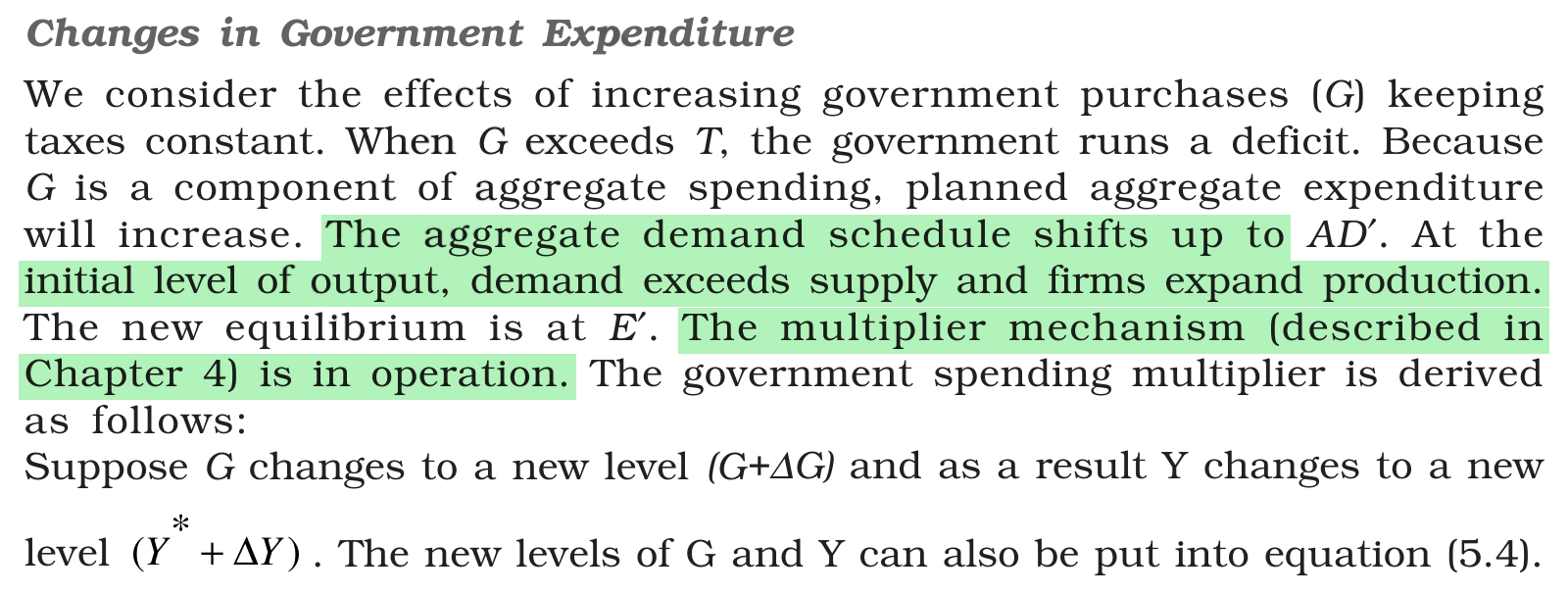
The major economic activities of the government that affect the aggregate demand for final goods and services can be summarized by the fiscal variables Tax (T) and Government Expenditure (G), both autonomous to our analysis. The government, through its expenditure G on final goods and services, adds to the aggregate demand like other firms and households. On the other hand, taxes imposed by the government take a part of the income away from the household, whose disposable income, therefore, becomes Yd = Y – T. Households spend only a fraction of this disposable income for consumption purpose. Hence, equation has to be modified in the following way to incorporate the government
Y = C̄ + Ī + G + c (Y – T )
Where, Y- Income, C-Consumption, G- Government Expenditure, I-Investment, c- Marginal Propensity to consume (MPC), T- tax.
An increase in government spending will lead to _________
Answer & explanation
Correct answer: option 3
The correct answer is Option (3) → Increase in income times multiplier.
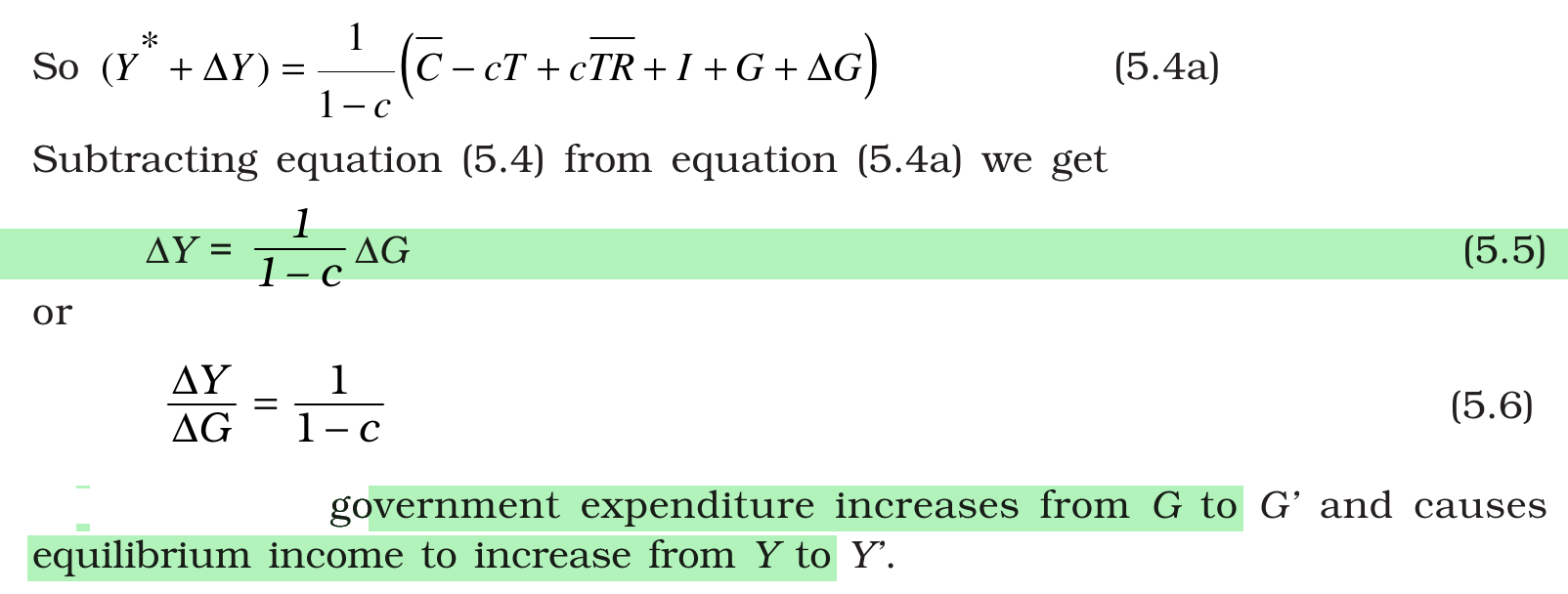
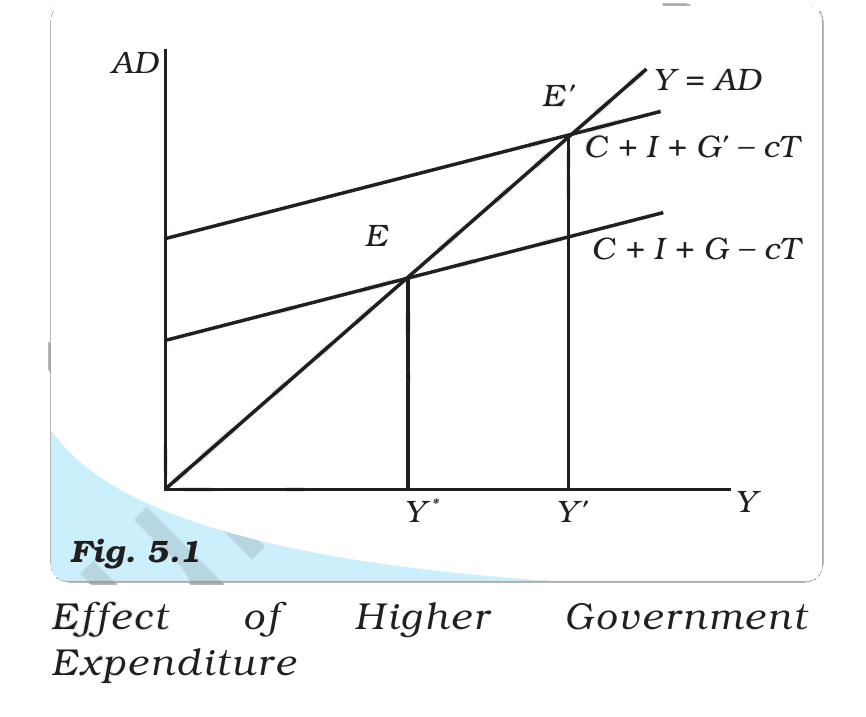
When the government spends more, aggregate demand rises; firms produce more, incomes rise, and people spend part of the extra income, raising income again, round after round. Income therefore rises by the government expenditure multiplier times the increase in spending:
ΔY = [1 ÷ (1 − c)] × ΔG
Why the other options are incorrect
Option (1) Increase in consumption times multiplier. — Incorrect. Consumption does rise as income rises, but it is income, not consumption, that rises by the multiplier times the change in G.
Option (2) Decrease in income times multiplier. — Incorrect. More government spending adds to aggregate demand, so income rises, not falls.
Option (4) Increase in Tax — Incorrect. In the passage both G and T are autonomous, decided by the government; an increase in G does not by itself change the taxes.
NCERT: Introductory Macroeconomics — Chapter 5: Government Budget and the Economy (2025-26)
|