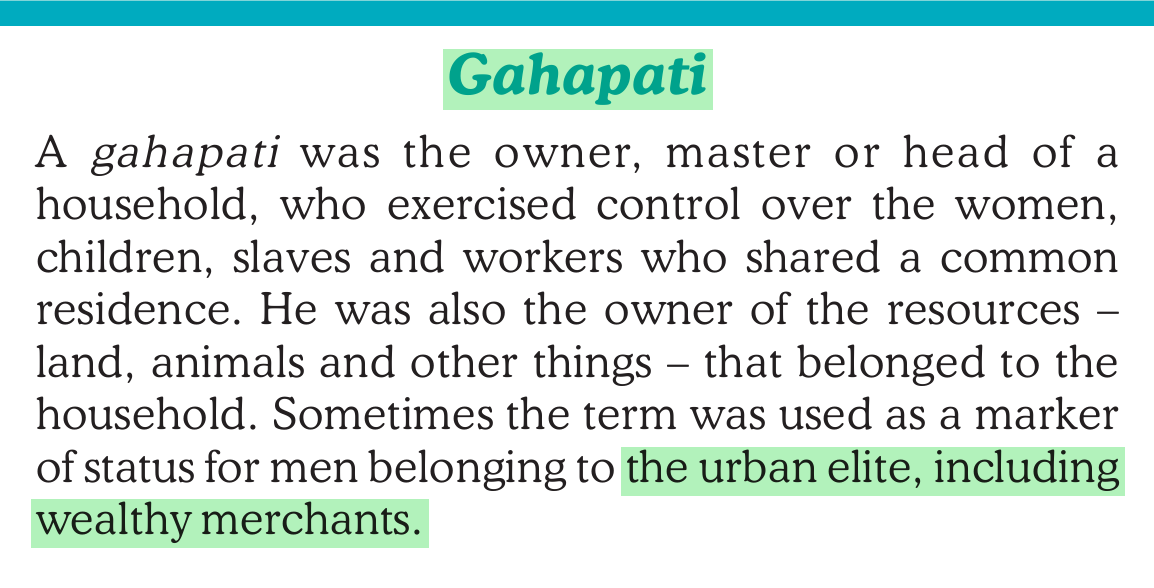
Which of the following statement is incorrect with reference to the term “Gahapati”?
Answer & explanation
Correct answer: option 4
The correct answer is Option (4) → It was sometimes used as a marker of status for men belonging to the urban elite, excluding wealthy merchants
Option (1) The owner, master or head of a household — Correct. This is the meaning of gahapati, a term often used in Pali texts for small peasants and large landholders.
Option (2) He exercised control over the women, children, slaves and workers who shared a common residence — Correct. As head of the household he controlled everyone who lived under the same roof.
Option (3) He was the owner of the resources – land, animals and other things — Correct. The land, animals and other things that belonged to the household were his.
Option (4) It was sometimes used as a marker of status for men belonging to the urban elite, excluding wealthy merchants — Incorrect. The term marked the status of men of the urban elite, including wealthy merchants, not excluding them. ‘Including’ became ‘excluding’. One swapped word, and a margin note became a wrong statement. Read margin notes as slowly as the main text.
NCERT (2025-26): “5.3 Differences in rural society … What is evident is that there was a growing differentiation amongst people engaged in agriculture – stories, especially within the Buddhist tradition, refer to landless agricultural labourers, small peasants, as well as large landholders. The term gahapati was often used in Pali texts to designate the second and third categories.…”
|