CUETMOCK
  • Pricing
  • Mentors
Log inStart freeStart free mocks→

First test, then trust

Try a free CUET mock test.

Join 5,00,000+ students who rehearsed exam day on the exact NTA screen before sitting CUET. On the web and on Android.

Start free mocks →Get the Android app
CUETMOCK

India's #1 CUET Mock Test Platform. Original NCERT-based questions on the exact NTA exam screen — trusted by 5,00,000+ students since CUET 2022.

Get it onGoogle PlayScan to download the CUETMOCK app

Mock tests

  • CUET mock test series
  • Commerce mocks
  • Humanities (Arts) mocks
  • Science mocks
  • Languages & GAT mocks
  • Free practice questions
  • Pricing

Resources

  • CUET exam guide
  • CUET syllabus
  • Universities accepting CUET
  • Expert blogs
  • News & notifications
  • Webinars & counselling
  • CUET score calculator
  • How we estimate your rank
  • FAQs

Company

  • About us
  • Our leadership & team
  • Our toppers
  • Mentors
  • For schools
  • Contact us
  • Terms
  • Privacy
  • Refund policy

Talk to us

+91 7696 6630 56info@cuetmock.comWhatsApp us

Our other platforms

  • JEE Mock — For IIT-JEE aspirants
  • NEET Mock — For NEET aspirants

Newsletter

Exam updates, study material and offers — no spam.

© 2026 NYC Ventures Pvt. Ltd.

701-702, Royal Business Park, Zirakpur, Punjab - 140603

  • Terms of use
  • Privacy policy
  • Refund policy
  • Contact us

iCUETMOCK is an independent preparation platform, not affiliated with the National Testing Agency (NTA). Always check exam details on the official NTA website.

  • Home
  • Mock tests
  • CUET guide
  • Pricing
  • Log in
Home/Practice questions/Political Science
Political ScienceContemporary World Politics: Contemporary South Asia

Arrange the following agreements/treaties signed between India and Pa…

Arrange the following agreements/treaties signed between India and Pakistan in chronological order:

A. Tashkent Agreement

B. Simla Agreement

C. Indus Waters Treaty

D. Agreement not to attack nuclear installations and facilities of each other

Choose the correct answer from the options given below:

Answer & explanation+

Correct answer: option 3

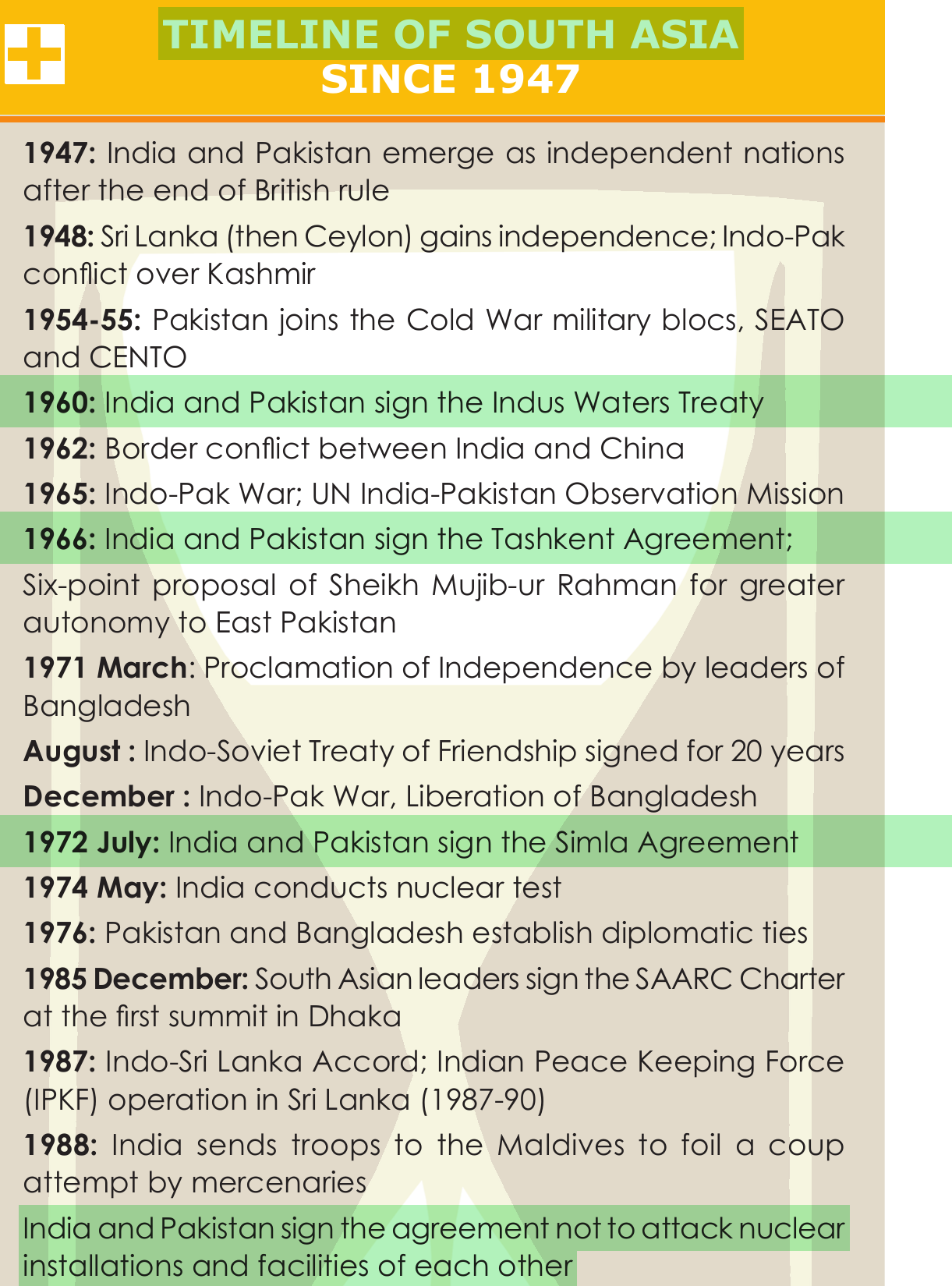
The correct answer is Option (3) → C, A, B, D

(C) Indus Waters Treaty — 1960.

(A) Tashkent Agreement — 1966.

(B) Simla Agreement — July 1972.

(D) Agreement not to attack nuclear installations and facilities of each other — 1988.


NCERT: Contemporary World Politics — Chapter 3: Contemporary South Asia (2025-26)

NCERT extract

Advertisement

Practise more on Contemporary World Politics: Contemporary South Asia

Chapter-wise mocks on the real NTA exam screen, with solutions and your rank. Your first mocks are free.

Start free mocks →

Advertisement

Next questions

  1. Predict the major product formed when propene reacts with HIChemistry · Organic: Haloalkanes and Haloarenes
  2. Match the LIST-I with LIST-IILIST-ILIST-IIA.Unrecorded Assets are transferred toI.Old partnersB.On admission of a partner, who will sacrifi…Accountancy Part A · Admission of a Partner
  3. A random sample of 17 values from a normal population has a mean of 105 cm and the sample standard deviation is 8.489. If normal population…Applied Maths. Section B2 · Inferential Statistics
  4. A circular wire loop of radius R is placed in the x-y plane centered at origin O. A square loop of side 'a' (a << R) of single turn is plac…Physics · Electromagnetic Induction
  5. Mukesh and Vanshika are partners. They agreed to share profits in the ratio of 3:2.Their capital balances on 01st April, 2024 were Rs. 15,0…Accountancy Part A · Accounting for Partnership
  6. A and B are partners sharing profits in the ratio of 2:3. They admitted C as a new partner for 1/5 share in the future profits of the firm.…Accountancy Part A · Admission of a Partner
  7. Choose the correct option to fill in the blank in the given sentence:He did not _________ to my request.English · Homonyms
  8. Identify the advantage of functional structure:Business Studies · Organising
  9. Which of the following statement is not true about the ‘Mansabdari’ system under the Mughals?History · Medieval India: Peasants, Zamindars and the State
  10. Which of the following statement is incorrect with reference to the term “Gahapati”?History · Ancient India: Kings, Farmers and Towns