
CUETMOCK
  • Pricing
  • Mentors
Log inStart freeStart free mocks→

First test, then trust

Try a free CUET mock test.

Join 5,00,000+ students who rehearsed exam day on the exact NTA screen before sitting CUET. On the web and on Android.

Start free mocks →Get the Android app
CUETMOCK

India's #1 CUET Mock Test Platform. Original NCERT-based questions on the exact NTA exam screen — trusted by 5,00,000+ students since CUET 2022.

Get it onGoogle PlayScan to download the CUETMOCK app

Mock tests

  • CUET mock test series
  • Commerce mocks
  • Humanities (Arts) mocks
  • Science mocks
  • Languages & GAT mocks
  • Free practice questions
  • Pricing

Resources

  • CUET exam guide
  • CUET syllabus
  • Universities accepting CUET
  • Expert blogs
  • News & notifications
  • Webinars & counselling
  • CUET score calculator
  • How we estimate your rank
  • FAQs

Company

  • About us
  • Our leadership & team
  • Our toppers
  • Mentors
  • For schools
  • Contact us
  • Terms
  • Privacy
  • Refund policy

Talk to us

+91 7696 6630 56info@cuetmock.comWhatsApp us

Our other platforms

  • JEE Mock — For IIT-JEE aspirants
  • NEET Mock — For NEET aspirants

Newsletter

Exam updates, study material and offers — no spam.

© 2026 NYC Ventures Pvt. Ltd.

701-702, Royal Business Park, Zirakpur, Punjab - 140603

  • Terms of use
  • Privacy policy
  • Refund policy
  • Contact us

iCUETMOCK is an independent preparation platform, not affiliated with the National Testing Agency (NTA). Always check exam details on the official NTA website.

  • Home
  • Mock tests
  • CUET guide
  • Pricing
  • Log in
Home/Practice questions/Chemistry
ChemistryOrganic: Haloalkanes and Haloarenes

Propene reacts with HI to form major product as 2-bromopropane. Sugge…

Propene reacts with HI to form major product as 2-bromopropane. Suggest the rule applied / effect used  for predicting the major product .

Answer & explanation+

Correct answer: option 4

The correct answer is Option (4) → Markovnikov's rule

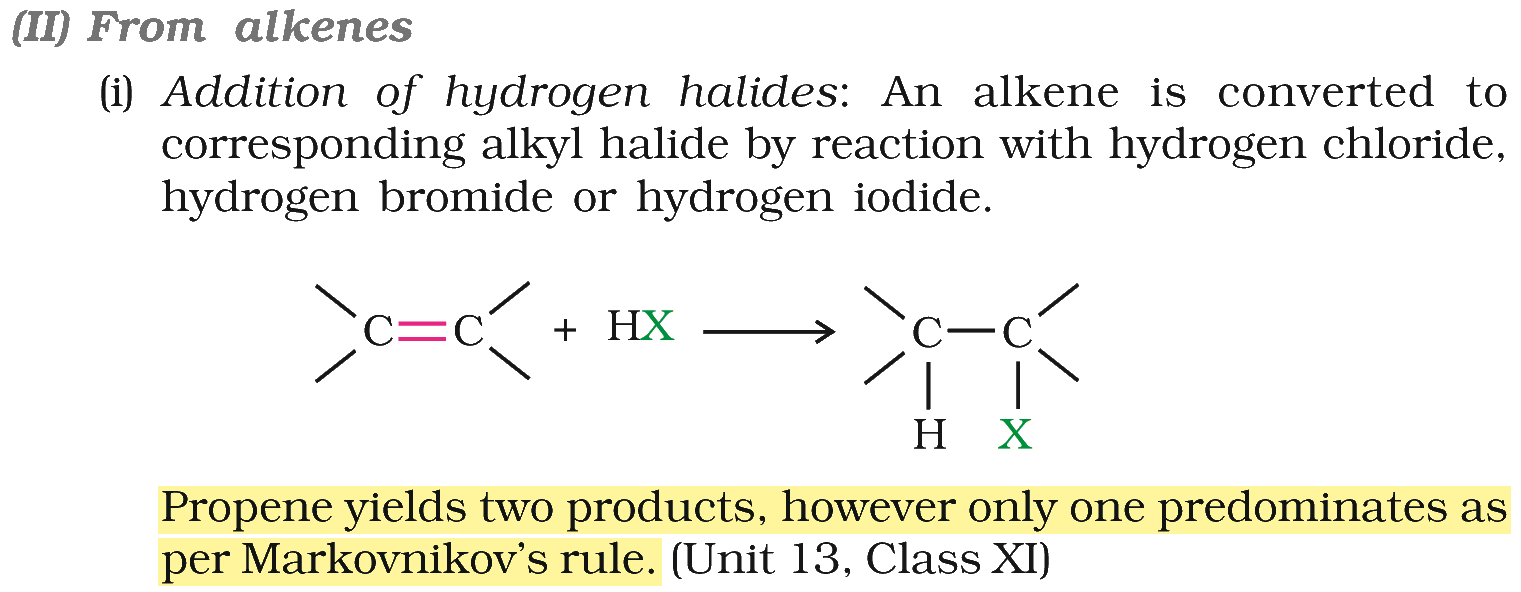
Markovnikov’s rule predicts the major product when an unsymmetrical reagent HX adds to an unsymmetrical alkene: the negative part (X) goes to the carbon atom of the double bond that carries fewer hydrogen atoms. The reason is the mechanism. \( \ce{H^{+}} \) adds first to give a carbocation, and the more stable carbocation is formed:

    \( \displaystyle \ce{CH3-CH=CH2 + H^+ -> CH3-CH^+-CH3}\quad\text{(2}^\circ\text{, more stable)} \)

The halide ion then attacks the secondary carbocation, so the halogen ends up on the middle carbon:

    \( \displaystyle \ce{CH3-CH=CH2 + HX -> CH3-CHX-CH3} \)

So the major product (a 2-halopropane) is predicted by Markovnikov’s rule.

Why the other options are incorrect

  • Option (1) Anti- Markovnikov's rule — Incorrect. This applies only to the addition of HBr in the presence of a peroxide (Kharasch effect), which goes through a free radical and gives 1-bromopropane. It does not work with HI or HCl.

  • Option (2) Saytzeff rule — Incorrect. This predicts the major alkene in elimination reactions (the more substituted alkene forms), not the product of an addition.

  • Option (3) Popoff's rule — Incorrect. This applies to the oxidation of unsymmetrical ketones, where the carbonyl group stays with the smaller alkyl group; it has nothing to do with addition to alkenes.

Note: It seems that there is a mistake in the original NTA paper, which prints that propene reacts with HI to form 2-bromopropane when it should read HBr (with HI the product is 2-iodopropane).

NCERT (2026-27 edition):
From Alkenes
Textbook extract

Advertisement

Practise more on Organic: Haloalkanes and Haloarenes

Chapter-wise mocks on the real NTA exam screen, with solutions and your rank. Your first mocks are free.

Start free mocks →

Advertisement

Next questions

  1. If y=e^π x and t=x^π , then which of following statements is/are TRUE?(A) (d^2y)/(dt^2)=displaystyley/(t^2)≤ft((π(x-1)+1)/(π))x (B) (d^2y)/…Maths. Section A · Continuity and Differentiability (Section A)
  2. Which one of the following is solid at room temperature?Chemistry · Organic: Haloalkanes and Haloarenes
  3. If y=xlog_e≤ft(displaystylex/(2+x)) , then x^3(d^2y)/(dx^2) is equal to:Maths. Section B1 · Continuity and Differentiability
  4. Arrange the following components of communication process in a logical sequence:A. MediaB. EncodingC. MessageD. DecodingChoose the correct…Business Studies · Directing
  5. Choose the correct palindrome sequence of 5'-GAATTC-3'Biology · Biotechnology -Principles and Processes
  6. In case Current Assets are Rs.4,50,000; Current Liabilities are Rs.2,00,000 and Inventory is Rs.50,000, what will be the Liquid Ratio ?Accountancy Part B · Accounting Ratios
  7. In the circuit shown in the figure, both the ammeter and the cell have negligible resistance. When the switch (S) is opened, the ammeter re…Physics · Current Electricity
  8. For the relation R defined below, where R and N denotes set of real numbers and set of natural numbers respectively, Match the LIST-I with…Maths. Section B1 · Relations and Functions
  9. Match the idioms given in List-I with their meanings given in List-IIList-I (Idioms)List-II (Meanings)(A) Eat one's words(I) Straightforwar…English · Grammar: Idioms
  10. Who painted the famous painting “Relief of Lucknow” in 1859?History · Modern India: Rebels and the Raj