
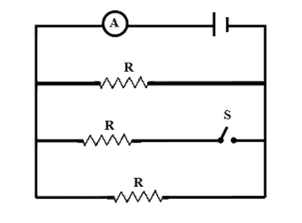
In the circuit shown in the figure, both the ammeter and the cell have negligible resistance. When the switch (S) is opened, the ammeter reads a current of 0.4 A. Now when the switch is closed, the current through the ammeter will be
Answer & explanation
Correct answer: option 1
The correct answer is Option (1) → 0.6 A
The cell and the ammeter have negligible resistance, so all the resistor branches are connected directly across the cell and each has the full cell voltage V across it. The ammeter reads the sum of the branch currents, each equal to V/R.
With the switch open, two branches carry current:
\( \displaystyle I_{\mathrm{open}} = \frac{V}{R} + \frac{V}{R} = \frac{2V}{R} = 0.4\,\mathrm{A} \)
\( \displaystyle \frac{V}{R} = 0.2\,\mathrm{A} \)
With the switch closed, the third branch also conducts:
\( \displaystyle I_{\mathrm{closed}} = \frac{3V}{R} = 3 \times 0.2\,\mathrm{A} \)
\( I_{\mathrm{closed}} = 0.6\,\mathrm{A} \)
Shortcut: The current is proportional to the number of conducting branches, so \( I = 0.4\,\mathrm{A} \times \frac{3}{2} = 0.6\,\mathrm{A} \).