
CUETMOCK
  • Pricing
  • Mentors
Log inStart freeStart free mocks→

First test, then trust

Try a free CUET mock test.

Join 5,00,000+ students who rehearsed exam day on the exact NTA screen before sitting CUET. On the web and on Android.

Start free mocks →Get the Android app
CUETMOCK

India's #1 CUET Mock Test Platform. Original NCERT-based questions on the exact NTA exam screen — trusted by 5,00,000+ students since CUET 2022.

Get it onGoogle PlayScan to download the CUETMOCK app

Mock tests

  • CUET mock test series
  • Browse all papers
  • Commerce mocks
  • Humanities (Arts) mocks
  • Science mocks
  • Languages & GAT mocks
  • Free practice questions
  • Pricing

Resources

  • CUET exam guide
  • CUET syllabus
  • Universities accepting CUET
  • Expert blogs
  • News & notifications
  • Webinars & counselling
  • CUET score calculator
  • How we estimate your rank
  • FAQs

Company

  • About us
  • Our leadership & team
  • Our toppers
  • Mentors
  • For schools
  • Contact us
  • Terms
  • Privacy
  • Refund policy

Talk to us

+91 7696 6630 56info@cuetmock.comWhatsApp us

Our other platforms

  • JEE Mock — For IIT-JEE aspirants
  • NEET Mock — For NEET aspirants

Newsletter

Exam updates, study material and offers — no spam.

© 2026 NYC Ventures Pvt. Ltd.

701-702, Royal Business Park, Zirakpur, Punjab - 140603

  • Terms of use
  • Privacy policy
  • Refund policy
  • Contact us

iCUETMOCK is an independent preparation platform, not affiliated with the National Testing Agency (NTA). Always check exam details on the official NTA website.

  • Home
  • Mock tests
  • CUET guide
  • Pricing
  • Log in
Home/Practice questions/Chemistry
ChemistryOrganic: Alcohols, Phenols and Ethers

The product “C” for the following reaction will be

The product “C” for the following reaction will be

Figure for Q39

Answer & explanation+

Correct answer: option 1

The correct answer is Option (1) → Salicylaldehyde

The sequence converts benzene into phenol and then introduces a –CHO group ortho to –OH. Each step is a standard reaction:

  • Sulphonation (A): benzene heated with oleum (\( \ce{SO3} \) in conc. \( \ce{H2SO4} \)) gives benzenesulphonic acid.

        \( \displaystyle \ce{C6H6 + SO3} \xrightarrow{\text{conc. }\ce{H2SO4}\text{ (oleum)}} \ce{C6H5SO3H} \)

  • Alkali fusion (B): benzenesulphonic acid fused with NaOH gives sodium phenoxide, which on acidification gives phenol. This was an early industrial method for phenol.

        \( \displaystyle \ce{C6H5SO3H + 3NaOH} \xrightarrow{\text{fuse}} \ce{C6H5ONa + Na2SO3 + 2H2O} \)

        \( \displaystyle \ce{C6H5ONa + HCl -> C6H5OH + NaCl} \)

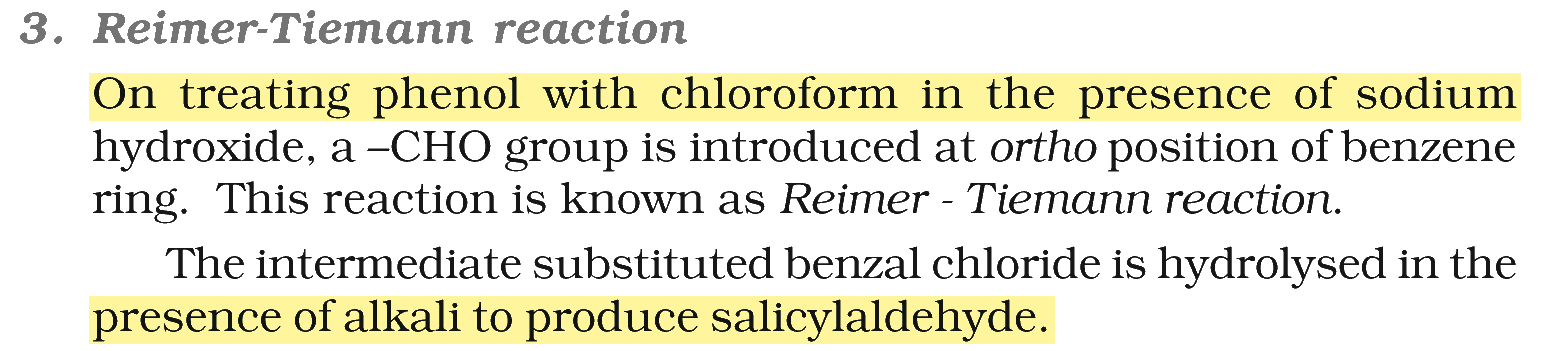
  • Reimer–Tiemann reaction (C): phenol treated with chloroform and aqueous NaOH gets a –\( \ce{CHCl2} \) group at the ortho position, which is hydrolysed by the alkali; acidification then gives salicylaldehyde (2-hydroxybenzaldehyde).

        \( \displaystyle \ce{C6H5OH + CHCl3 + 4NaOH -> o-C6H4(ONa)CHO + 3NaCl + 3H2O} \)

        \( \displaystyle \ce{o-C6H4(ONa)CHO + HCl -> o-C6H4(OH)CHO + NaCl} \)

So A is benzenesulphonic acid, B is phenol, and the product C is salicylaldehyde.

Why the other options are incorrect

  • Option (2) Phenol — Incorrect. Phenol is the intermediate B, formed before the Reimer–Tiemann step.

  • Option (3) o-Cresol — Incorrect. o-cresol has a –CH3 group; chloroform and alkali introduce a –CHO group, not a methyl group.

  • Option (4) Benzaldehyde — Incorrect. Benzaldehyde has no –OH group; it is made from benzene by the Gattermann–Koch reaction (CO, HCl, anhyd. \( \ce{AlCl3} \)) or from toluene by the Etard reaction.

NCERT (2026-27 edition):
Reimer-Tiemann Reaction
Textbook extract

Advertisement

Practise more on Organic: Alcohols, Phenols and Ethers

Chapter-wise mocks on the real NTA exam screen, with solutions and your rank. Your first mocks are free.

Start free mocks →

Advertisement

Next questions

  1. Under whose leadership the British adopted policies aimed at reforming Indian society by introducing Western education and Western ideas?History · Modern India: Rebels and the Raj
  2. A dining table costing Rs. 40,000 has a useful life of 10 years. If the annual depreciation is Rs. 2000, then its scrap value using a linea…Applied Maths. Section B2 · Financial Mathematics
  3. A p-n junction diode has a potential barrier of 0.5 V. If 1.5 V battery is used to forward bias the diode, the minimum value of resistance…Physics · Semiconductors and Electronic Devices
  4. Choose the appropriate option that conveys the correct meaning of the underlined expression:His avarice for making quick money proved to be…English · Grammar: Idioms
  5. Owner’s fund doesn’t comprise of:Business Studies · Financial Management
  6. Arrange the following examples from organisational context as per Maslow's Need Hierarchy Theory(A) Job Title(B) Achievement of Goals(C) Pe…Business Studies · Directing
  7. The graph showing variation of resistivity with temperature is for:Physics · Current Electricity
  8. Ms Rajni takes a loan of Rs. 25,00,000 at an interest of 10% per annum for a period of 20 years. Her EMI using a flat rate method is:Applied Maths. Section B2 · Financial Mathematics
  9. Arrange the following complexes in order of their decreasing conductivity values?A. [CoCl2(NH3)4]ClB. [CoCl(NH3)5]Cl2C. [Co(NH3)6]Cl3D. [Co…Chemistry · Inorganic: Coordination Compounds
  10. A resistance of 10 Ω and inductance L are connected in series with an alternating source of 100 V, 50 Hz. If the phase angle between the vo…Physics · Alternating Current