Arrange the following compounds in increasing order towards nucleophilic substitution reaction .
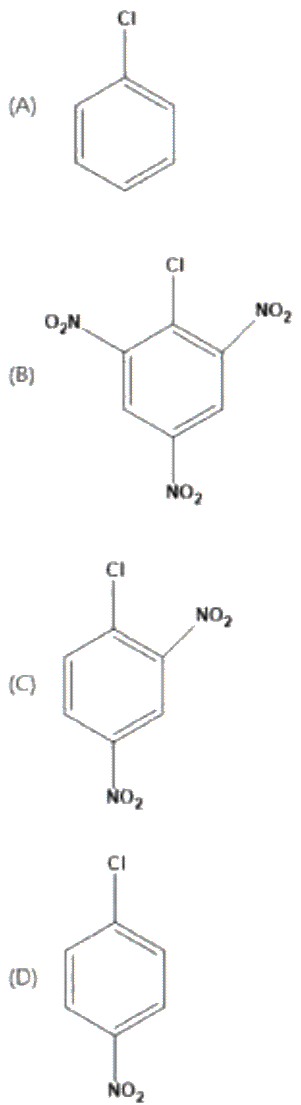
Choose the correct answer from the options given below:
Answer & explanation
Correct answer: option 2
The correct answer is Option (2) → (A),(D),(C),(B)
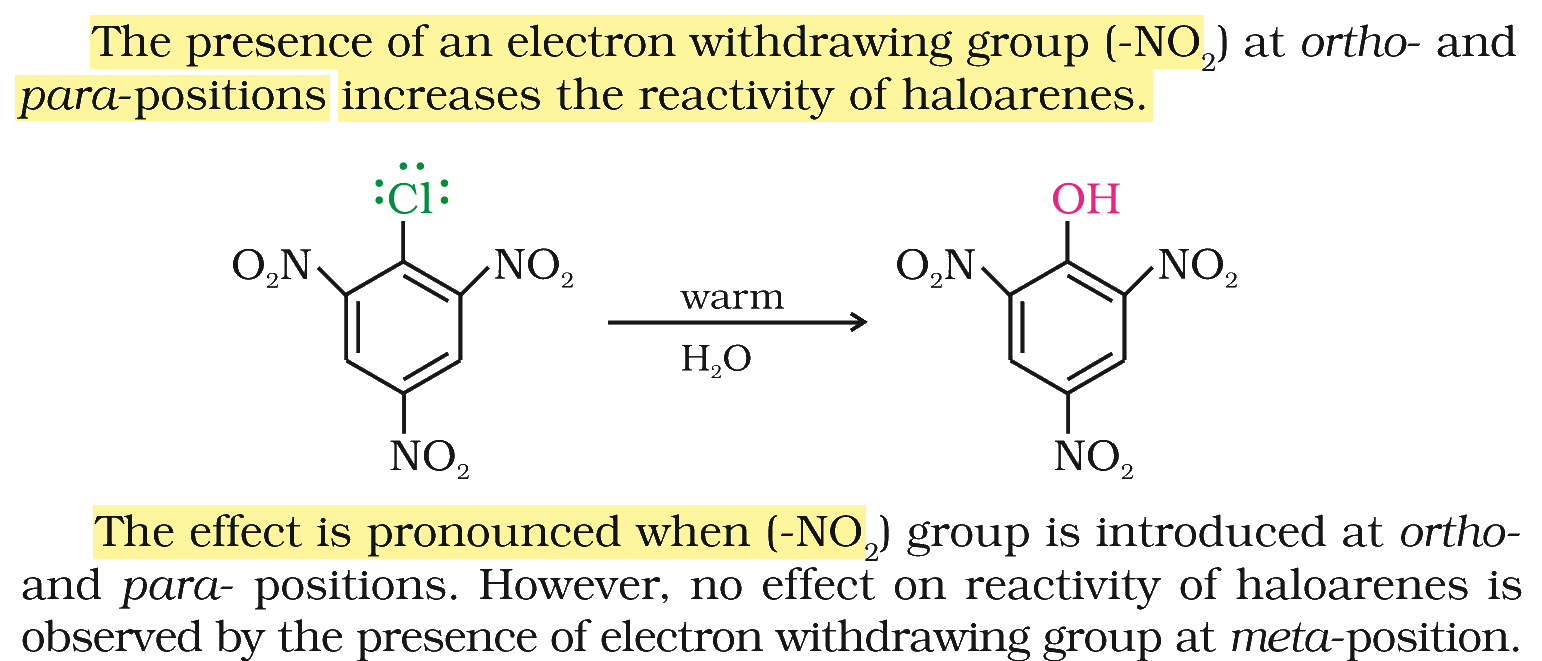
Aryl halides are very unreactive towards nucleophilic substitution. Resonance gives the C–Cl bond partial double bond character, the carbon is sp2 hybridised, and the electron-rich ring repels the incoming nucleophile.
The deciding factor here is the number of –NO2 groups at the ortho and para positions to chlorine. When the nucleophile attacks, a negatively charged intermediate forms. An –\( \ce{NO2} \) group at an ortho or para position spreads this negative charge onto its own oxygen atoms by resonance, stabilises the intermediate and speeds up the reaction. Each additional such group increases the reactivity further.
So the reactivity increases in the order:
no –\( \ce{NO2} \) < one –\( \ce{NO2} \) < two –\( \ce{NO2} \) < three –\( \ce{NO2} \)
Matching the given compounds (with the temperature at which each reacts with aqueous NaOH):
(A) chlorobenzene: no –\( \ce{NO2} \) group (needs 623 K and high pressure)
(D) 1-chloro-4-nitrobenzene: one –\( \ce{NO2} \) group, para (443 K)
(C) 1-chloro-2,4-dinitrobenzene: two –\( \ce{NO2} \) groups, ortho and para (368 K)
(B) 2-chloro-1,3,5-trinitrobenzene: three –\( \ce{NO2} \) groups, two ortho and one para (328 K, warm water is enough)
Shortcut: Chlorobenzene (A) is the least reactive and the trinitro compound (B) the most. Only Option (2) starts with (A) and ends with (B).
NCERT (2026-27 edition):
Reactions of Haloarenes – …