Equilibrium and Level of Employment
Read the passage carefully and answer the following questions:
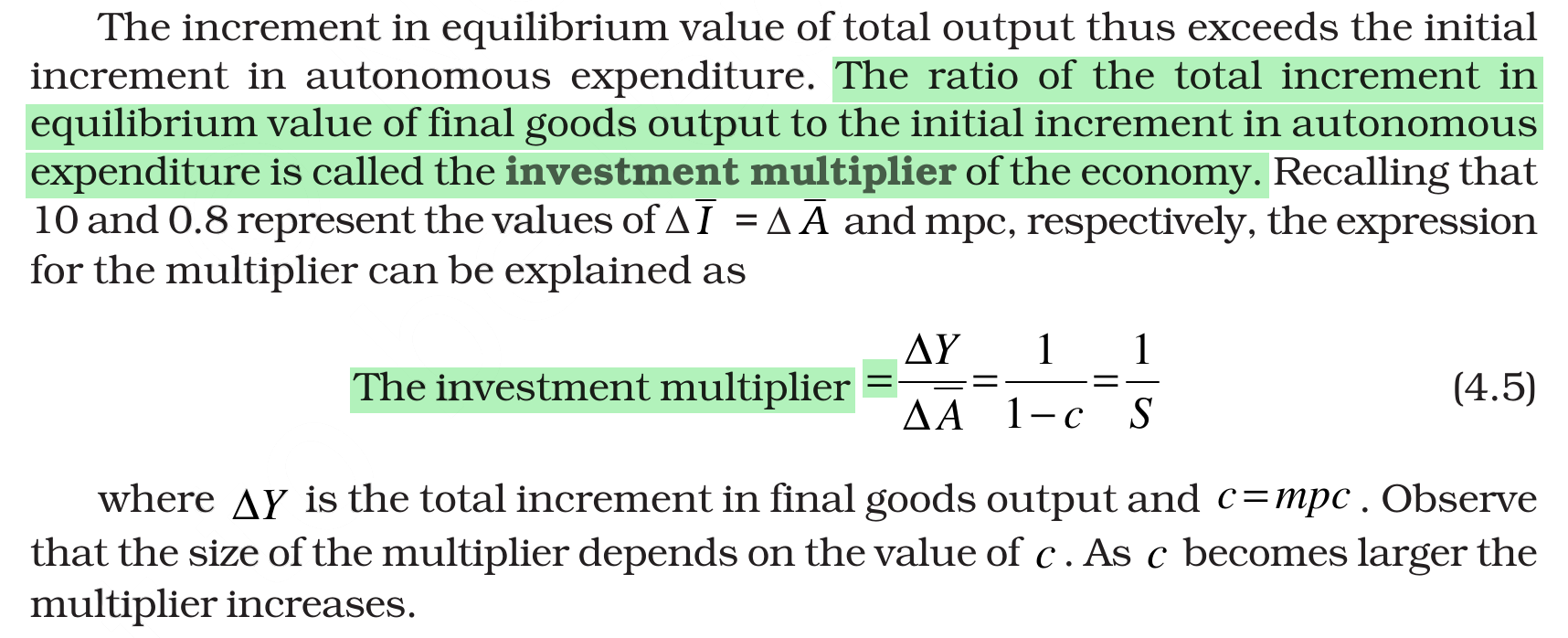
The equilibrium output in economy also determines level of employment, given quantities of other factors of production. This means that level of output determined by equality of Y with AD does not necessarily mean level of output at which everyone is employed. The full-employment level of income is that level of income where all factors of production are fully employed in production process. The equilibrium attained at point of equality of Y and AD by itself, does not signify full-employment of resources. Equilibrium only means that if left to itself, level of income in economy will not change even when there is unemployment in economy. The equilibrium level of output may be more or less than full-employment level of output. If it is less than full-employment of output, it is due to fact that demand is not enough to employ all factors of production; this leads to decline in prices in long run. On other hand, if equilibrium level of output is more than full-employment level, it is due to fact that demand is more than level of output produced at full-employment level; this leads to rise in prices in long run. The increment in equilibrium value of total output thus exceeds the initial increment in autonomous expenditure. The ratio of the total increment in equilibrium value of final goods output to the initial increment in autonomous expenditure is called the investment multiplier of the economy.
What is the expression for the investment multiplier?
Answer & explanation
Correct answer: option 3
The correct answer is Option (3) → 1/1-c
Money spent on new investment becomes income for others, who spend a part of it, and that spending becomes still more income in the next round. So output rises by more than the first increase in autonomous spending, and the ratio of the total rise in equilibrium output to that first rise is the investment multiplier:
Investment multiplier = ΔY/ΔA = 1/(1 − c) = 1/s
Here c is the marginal propensity to consume and s = 1 − c is the marginal propensity to save. The larger c is, the more of each round is spent again, and the larger the multiplier.
Why the other options are incorrect
Option (1) ΔY/A — Incorrect. The multiplier compares two changes: the change in output with the change in autonomous spending, ΔY/ΔA. Dividing the change in output by the whole of autonomous spending A does not give the multiplier; only with ΔA in the denominator would the expression be equal to 1/(1 − c).
Option (2) Y/C — Incorrect. This is income divided by consumption, the reciprocal of the average propensity to consume. It compares levels, not changes, so it says nothing about how far income rises when spending rises.
Option (4) Y/I — Incorrect. This is the level of income divided by the level of investment. It is a ratio of totals, not of increments, and does not measure the rise in income per unit rise in investment.
NCERT: Introductory Macroeconomics — Chapter 4: Determination of Income and Employment (2025-26)
|