Diazonium salts couple with phenols to form an orange-red color dye. The reaction requires
Answer & explanation
Correct answer: option 2
The correct answer is Option (2) → basic medium
In a coupling reaction, the arenediazonium ion acts as an electrophile and substitutes at the para position of a very reactive aromatic ring, joining the two rings through –N=N–. The diazonium ion is a weak electrophile, so the ring must be strongly activated.
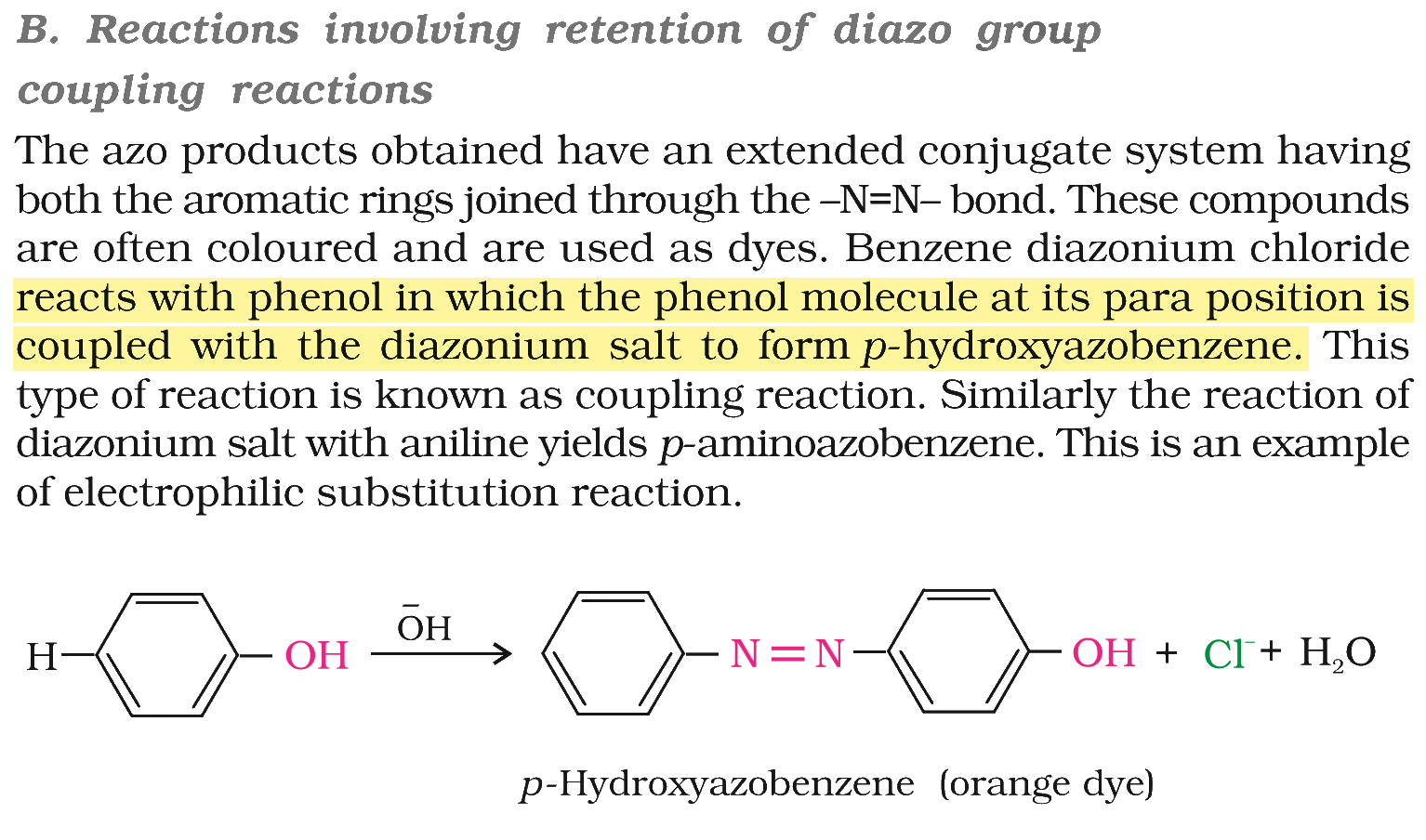
Phenol is therefore coupled in a mildly basic (alkaline) medium, about pH 9–10. The alkali converts phenol into the phenoxide ion; –\( \ce{O^{-}} \) activates the ring much more strongly than –OH, and coupling gives the orange dye p-hydroxyazobenzene:
\( \displaystyle \ce{C6H5N2^+Cl^- + C6H5OH} \xrightarrow{\ce{OH^-}} \ce{C6H5-N=N-C6H4-OH + Cl^- + H2O} \)
So the coupling of diazonium salts with phenols requires a basic medium.
Why the other options are incorrect
Option (1) acidic medium — Incorrect. In acid, phenol stays un-ionised and is not reactive enough. A mildly acidic medium is used for coupling with aniline, which gives yellow p-aminoazobenzene.
Option (3) neutral medium — Incorrect. Very little phenoxide ion is present, so coupling is too slow.
Option (4) catalyst — Incorrect. No catalyst is needed; the reaction is controlled by the pH of the medium.
NCERT (2026-27 edition):
Reactions Involving Retention of Diazo Group