
CUETMOCK
  • Pricing
  • Mentors
Log inStart freeStart free mocks→

First test, then trust

Try a free CUET mock test.

Join 5,00,000+ students who rehearsed exam day on the exact NTA screen before sitting CUET. On the web and on Android.

Start free mocks →Get the Android app
CUETMOCK

India's #1 CUET Mock Test Platform. Original NCERT-based questions on the exact NTA exam screen — trusted by 5,00,000+ students since CUET 2022.

Get it onGoogle PlayScan to download the CUETMOCK app

Mock tests

  • CUET mock test series
  • Commerce mocks
  • Humanities (Arts) mocks
  • Science mocks
  • Languages & GAT mocks
  • Free practice questions
  • Pricing

Resources

  • CUET exam guide
  • CUET syllabus
  • Universities accepting CUET
  • Expert blogs
  • News & notifications
  • Webinars & counselling
  • CUET score calculator
  • How we estimate your rank
  • FAQs

Company

  • About us
  • Our leadership & team
  • Our toppers
  • Mentors
  • For schools
  • Contact us
  • Terms
  • Privacy
  • Refund policy

Talk to us

+91 7696 6630 56info@cuetmock.comWhatsApp us

Our other platforms

  • JEE Mock — For IIT-JEE aspirants
  • NEET Mock — For NEET aspirants

Newsletter

Exam updates, study material and offers — no spam.

© 2026 NYC Ventures Pvt. Ltd.

701-702, Royal Business Park, Zirakpur, Punjab - 140603

  • Terms of use
  • Privacy policy
  • Refund policy
  • Contact us

iCUETMOCK is an independent preparation platform, not affiliated with the National Testing Agency (NTA). Always check exam details on the official NTA website.

  • Home
  • Mock tests
  • CUET guide
  • Pricing
  • Log in
Home/Practice questions/Chemistry
ChemistryOrganic: Aldehydes, Ketones and Carboxylic Acids

Which of the following reactions does not produce ketone?
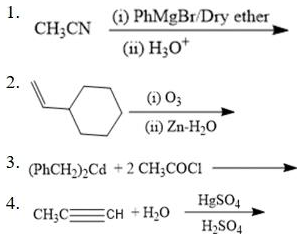
Which of the following reactions does not produce ketone?

Figure for Q23

Answer & explanation+

Correct answer: option 2

The correct answer is Option (2) → 2

A ketone has a C=O group bonded to two carbon groups (R–CO–R′), whereas an aldehyde has at least one hydrogen on the C=O carbon. Ketones can be made from nitriles with Grignard reagents, from acyl chlorides with dialkylcadmium, by hydration of alkynes other than ethyne, and by ozonolysis of alkenes whose double-bond carbon carries two carbon groups.

  • Option (1) 1 — Produces a ketone (acetophenone). The Grignard reagent adds to the C≡N group, and hydrolysis of the imine formed gives acetophenone:

        \( \displaystyle \ce{CH3-C#N + C6H5MgBr} \xrightarrow{\text{dry ether}} \ce{CH3-C(=NMgBr)-C6H5} \)

        \( \displaystyle \ce{CH3-C(=NMgBr)-C6H5 + 2H2O} \xrightarrow{\ce{H+}} \ce{CH3-CO-C6H5 + NH3 + Mg(OH)Br} \)

  • Option (2) 2 — Does not produce a ketone (gives two aldehydes). The double bond is at the end of the chain, \( \ce{CH2=CH} \)– on the ring; ozonolysis turns each carbon into C=O, and each carries a hydrogen:

        \( \displaystyle \ce{C6H11-CH=CH2} \xrightarrow[\text{(ii) }\ce{Zn}/\ce{H2O}]{\text{(i) }\ce{O3}} \ce{C6H11-CHO + HCHO} \)

  • Option (3) 3 — Produces a ketone (1-phenylpropan-2-one). A dialkylcadmium converts an acyl chloride into a ketone:

        \( \displaystyle \ce{(C6H5CH2)2Cd + 2CH3COCl -> 2C6H5CH2COCH3 + CdCl2} \)

  • Option (4) 4 — Produces a ketone (propanone). Water adds to propyne by Markovnikov’s rule; the enol formed changes to propanone:

        \( \displaystyle \ce{CH3-C#CH + H2O} \xrightarrow{\ce{HgSO4}/\ce{H2SO4}} \ce{CH3COCH3} \)

Advertisement

Practise more on Organic: Aldehydes, Ketones and Carboxylic Acids

Chapter-wise mocks on the real NTA exam screen, with solutions and your rank. Your first mocks are free.

Start free mocks →

Advertisement

Next questions

  1. Fill in the blank with the most appropriate option given below:Disruptive forces in the country are fatal _____ the integrity of the nation.English · Grammar: Preposition
  2. Which one of the following is not a consequence of the disintegration of USSR?Political Science · Contemporary World Politics: End of Bi-Polarity
  3. Among the following, which are examples of first-order reactions?(A) ^226_88Ra → ^4_2He + ^222_86Rn (B) 2NH3 xrightarrow[Pt catalyst]1130K…Chemistry · Physical: Chemical Kinetics
  4. Choose the correct option as one word substitution for the given phrase:Analysis of handwritingEnglish · Study of Subject
  5. Which among the following are part of India’s Security Strategy?(A) Poverty and inequality are not seen as threat(B) Strengthening its mili…Political Science · Contemporary World Politics: Security in the Contemporary World
  6. If x=4t^3 and y=6t^2 then (d^2y)/(dx^2) at t=1 isApplied Maths. Section B2 · Calculus
  7. Capital employed by a partnership firm is Rs. 15,00,000. Its average profit is Rs. 1,80,000. The normal rate of return in similar type of b…Accountancy Part A · Admission of a Partner
  8. The value of m satisfying m≡ 12±od 7 is:Applied Maths. Section B2 · Numbers, Quantification and Numerical Applications
  9. In a chemical reaction, which is the rate-determining step?Chemistry · Physical: Chemical Kinetics
  10. Which of the following indigenous peoples are correctly matched with the region they inhabit?A. People of the Cordillera region - Philippin…Political Science · Contemporary World Politics: Environment and Natural Resources