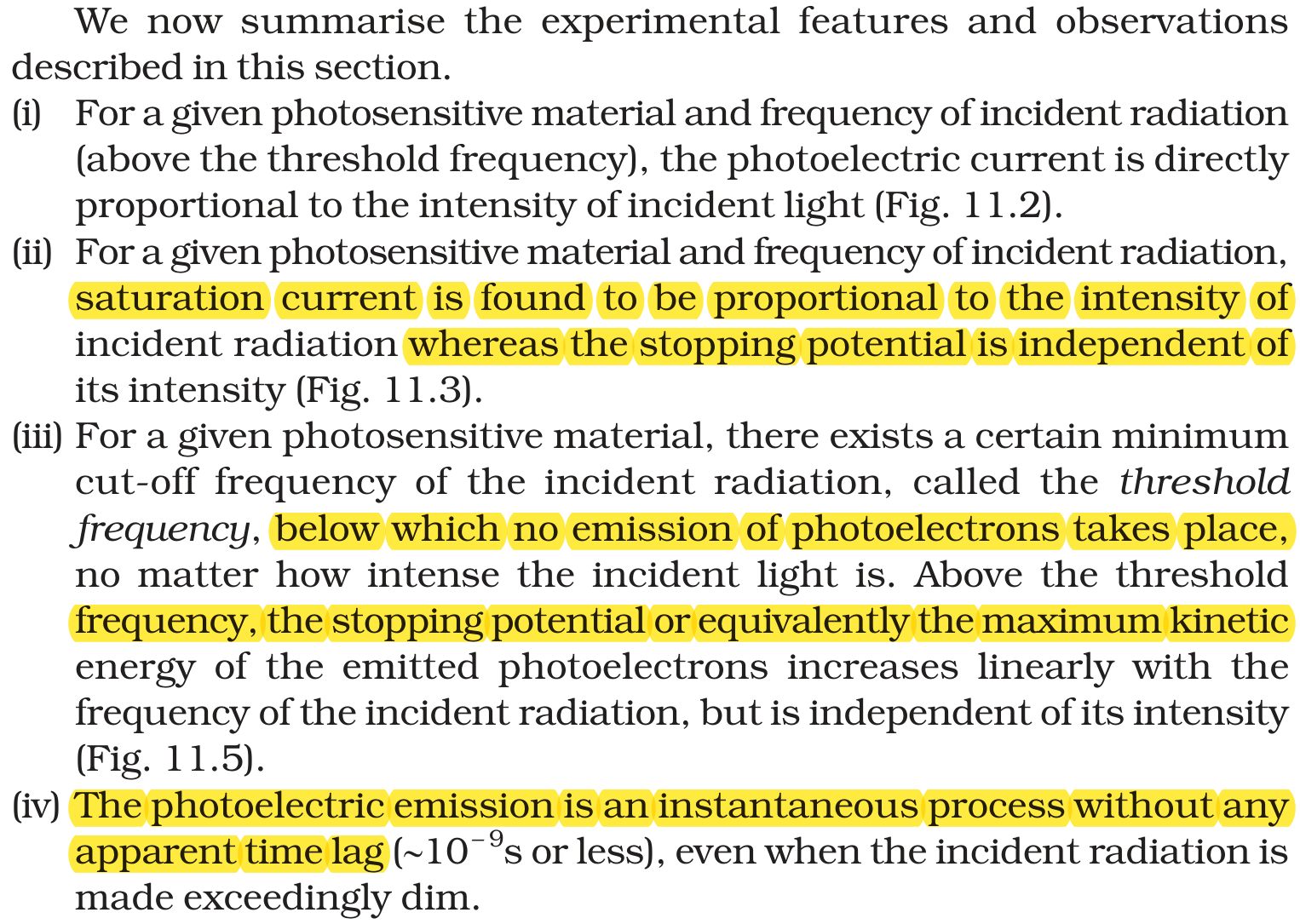
Read the following statements about the photoelectric effect and choose the correct statement only.
(A) A light of wavelength above a threshold cannot eject the electron from a photosensitive metal.
(B) Maximum kinetic energy of the emitted photoelectrons is determined by the energy of each photon and the work function of the photosensitive metal.
(C) There is no apparent time lag between the incidence of light and ejection of electrons from the photosensitive material.
(D) On increasing the intensity of incident light, keeping the frequency constant, saturation current increases but the cut-off potential remains unchanged.
Choose the correct answer from the options given below:
Answer & explanation
Correct answer: option 3
The correct answer is Option (3) → (A), (B), (C) and (D)
In the photoelectric effect one photon of energy \( h\nu \) gives all its energy to one electron, which escapes only if this is at least the work function \( \phi_0 \): \( K_{\max} = h\nu - \phi_0 \).
(A) A light of wavelength above a threshold cannot eject the electron from a photosensitive metal. — Correct. Above the threshold wavelength each photon has less energy than \( \phi_0 \), however intense the light is.
(B) Maximum kinetic energy of the emitted photoelectrons is determined by the energy of each photon and the work function of the photosensitive metal. — Correct. This is Einstein’s equation \( K_{\max} = h\nu - \phi_0 \).
(C) There is no apparent time lag between the incidence of light and ejection of electrons from the photosensitive material. — Correct. The energy arrives in a single photon–electron collision, so emission is practically instantaneous.
(D) On increasing the intensity of incident light, keeping the frequency constant, saturation current increases but the cut-off potential remains unchanged. — Correct. More photons per second eject more electrons, but each photon has the same energy, so \( K_{\max} \) and the cut-off potential do not change.
NCERT (2026-27):
Effect of Frequency of Incident Radiation on Stopping Potential – …