
If a 30 meter ladder is placed against a 15 meter wall such that it just reaches the top of the wall, then the elevation of the ladder with wall is?
Answer & explanation
Correct answer: option 1
The correct answer is Option (1) → 30°
Note: The given answer is as per the official NTA Answer Key. However, there seems to be a mistake in the question, which asks for the elevation of the ladder “with wall”: the angle of elevation, measured from the ground, is 30°, but the angle the ladder makes with the wall is 60° (Option (3)), as explained below. NTA’s question points at the wall, but its answer stays on the ground.
The ladder, the wall and the ground form a right triangle: the wall stands at 90° to the ground, the ladder is the hypotenuse (30 m), and the wall is the side opposite the angle at the foot of the ladder (15 m). The angle of elevation of the ladder is the angle it makes with the ground at its foot.
The sine of that angle is the opposite side over the hypotenuse: \(\displaystyle\sin\theta=\frac{15}{30}=\frac{1}{2}\)
The angle whose sine is one half is 30°, so \(\theta=30^{\circ}\)
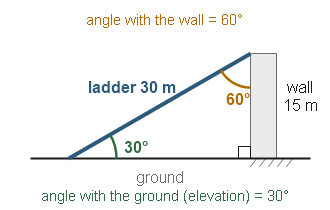
The angle at the top, between the ladder and the wall, is \(90^{\circ}-30^{\circ}=60^{\circ}\), since the three angles of the triangle add up to 180°; the elevation is the angle at the ground.