
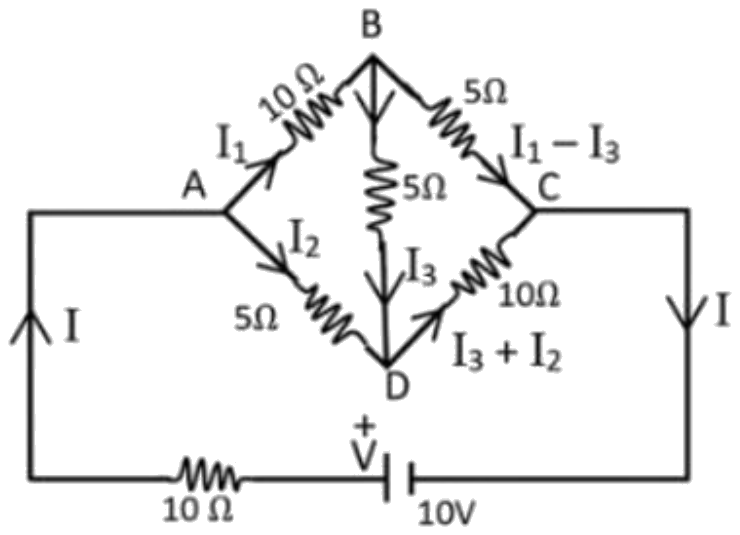
In the given electrical circuit, when Kirchhoff’s \(2^{\mathrm{nd}}\) law is applied to the loop ABDA, the equation will be:
Answer & explanation
Correct answer: option 1
The correct answer is Option (1) → \(2I_1 + I_3 - I_2 = 0\)
Kirchhoff’s second law (loop rule): the algebraic sum of the potential changes around any closed loop is zero. Going through a resistor in the direction of its current gives a drop \( -IR \); going against the current gives a rise \( +IR \).
Readings from the figure for the loop ABDA:
\( A \to B:\ 10\,\Omega,\ \text{current } I_1 \text{ along the path} \)
\( B \to D:\ 5\,\Omega,\ \text{current } I_3 \text{ along the path} \)
\( D \to A:\ 5\,\Omega,\ \text{current } I_2 \text{ from A to D, i.e. against the path} \)
The loop contains no cell, so
\( \displaystyle -10I_1 - 5I_3 + 5I_2 = 0 \)
Dividing by \( -5 \):
\( \displaystyle 2I_1 + I_3 - I_2 = 0 \)