Why is a cellulose acetate membrane used in reverse osmosis?
Answer & explanation
Correct answer: option 2
The correct answer is Option (2) → Cellulose acetate is permeable to water but impermeable to impurities.
In osmosis, solvent flows through a semipermeable membrane from pure solvent (or a dilute solution) into a more concentrated solution. The pressure that just stops this flow is the osmotic pressure.
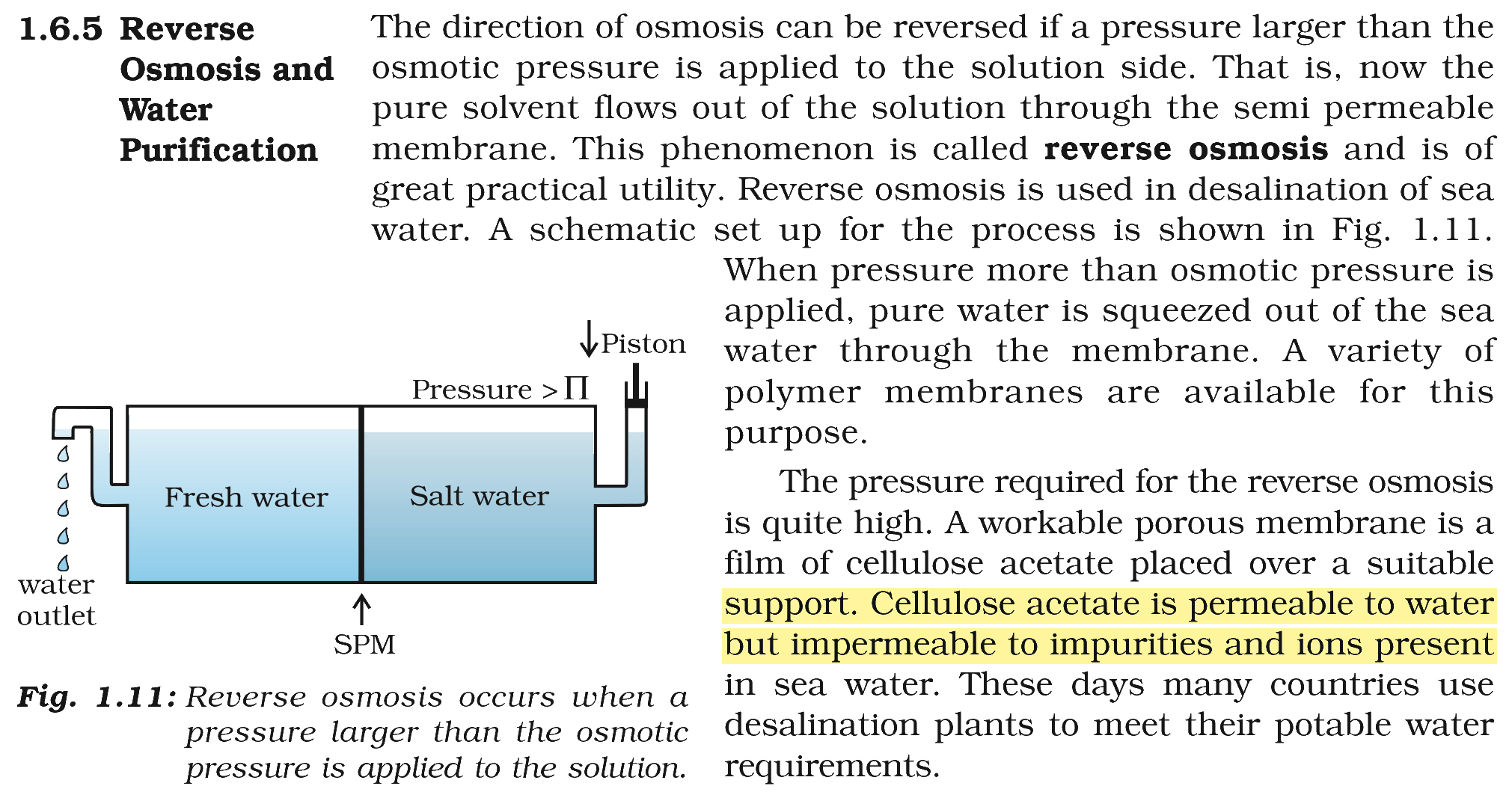
If a pressure larger than the osmotic pressure is applied on the solution side, the flow is reversed: pure solvent is pushed out of the solution through the membrane. This is reverse osmosis, and it is used for the desalination of sea water.
For this to work, the membrane must let water molecules pass but hold back the dissolved salts and other impurities. A film of cellulose acetate does this: it is permeable to water but impermeable to impurities and ions.
Why the other options are incorrect
Option (1) Cellulose acetate is impermeable to both water & impurities — Incorrect. Then nothing could pass through the membrane and no pure water would be obtained.
Option (3) Cellulose acetate is permeable to impurities — Incorrect. If impurities could pass, they would come out with the water and the water would not be purified.
Option (4) Cellulose acetate is impermeable to water — Incorrect. Water must pass through the membrane; that is the whole purpose of reverse osmosis.
NCERT (2026-27 edition):
Reverse Osmosis and Water Purification