Which of the following statements is incorrect for potassium dichromate?
Answer & explanation
Correct answer: option 2
The correct answer is Option (2) → The dichromate ion consists of two tetrahedra sharing one corner with Cr–O–Cr bond angle of 162°.
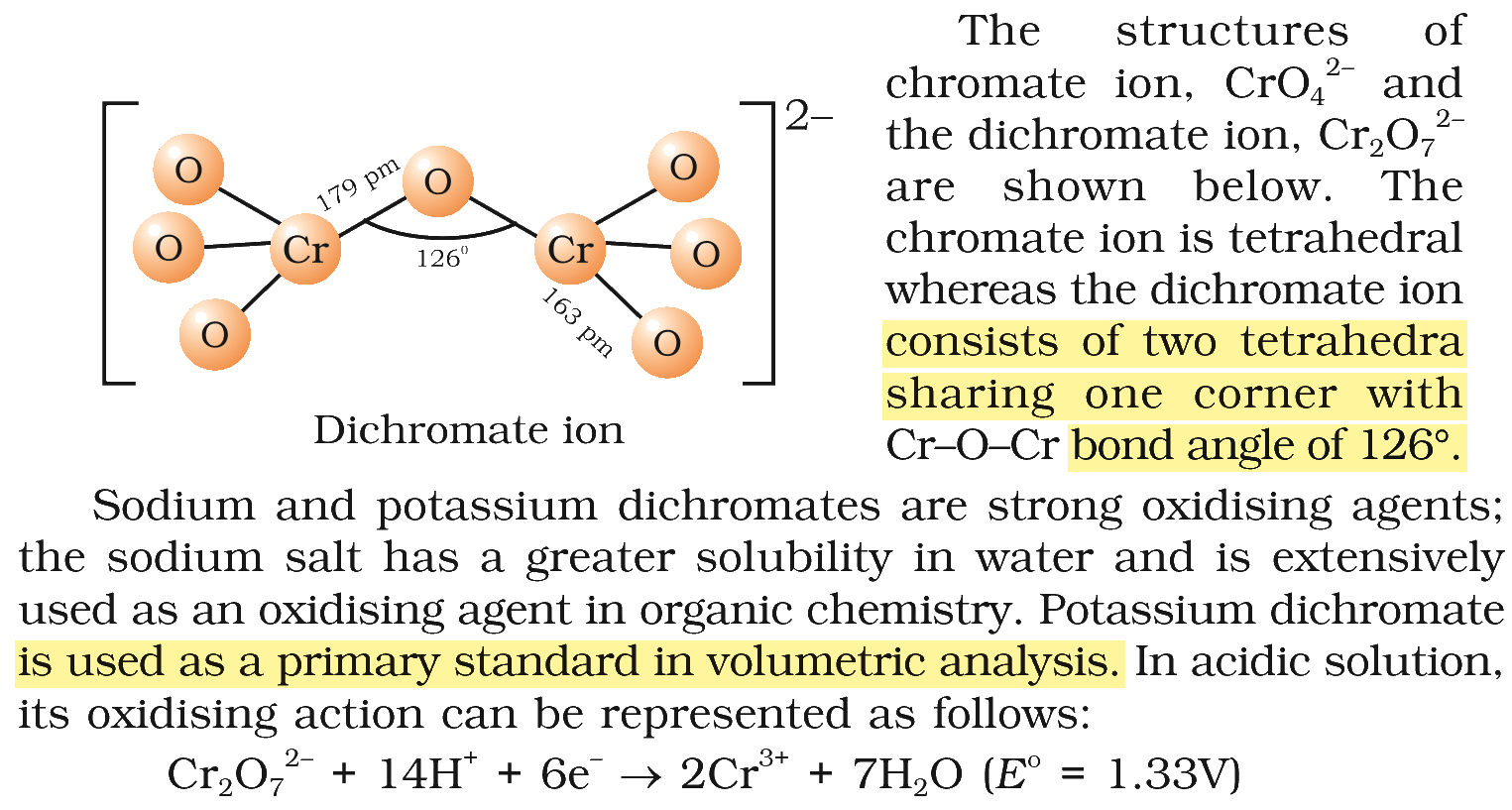
In the chromate ion, \( \ce{CrO4^{2-}} \), four oxygen atoms surround chromium tetrahedrally. The dichromate ion, \( \ce{Cr2O7^{2-}} \), is made of two such \( \ce{CrO4} \) tetrahedra that share one corner oxygen. The six terminal Cr–O bonds are equivalent, and the bridging Cr–O–Cr angle is 126°.
Option (1) The oxidation state of chromium is +6. — A correct statement. In \( \ce{K2Cr2O7} \): 2(+1) + 2x + 7(−2) = 0, so x = +6.
Option (2) The dichromate ion consists of two tetrahedra sharing one corner with Cr–O–Cr bond angle of 162°. — The incorrect statement. The two tetrahedra do share one corner, but the Cr–O–Cr angle is 126°, not 162°.
Option (3) Potassium dichromate is used as a primary standard in volumetric analysis. — A correct statement. It can be obtained very pure, is not hygroscopic and is stable, so a standard solution can be made by direct weighing (e.g. for estimating \( \ce{Fe^{2+}} \)).
Option (4) Acidified potassium dichromate oxidises iodides to iodine. — A correct statement. In acid, dichromate is a strong oxidising agent and is itself reduced to \( \ce{Cr^{3+}} \):
\( \displaystyle \ce{Cr2O7^2- + 14H^+ + 6I^- -> 2Cr^3+ + 7H2O + 3I2} \)
NCERT (2026-27 edition):
Oxides and Oxoanions of Metals – …