Which of the following statements are true for the elevation of boiling point?
(A) The boiling point of a solution is always higher than the boiling point of the pure solvent in which the solution is prepared.
(B) The boiling point of a solution is always lower than the boiling point of the pure solvent in which the solution is prepared.
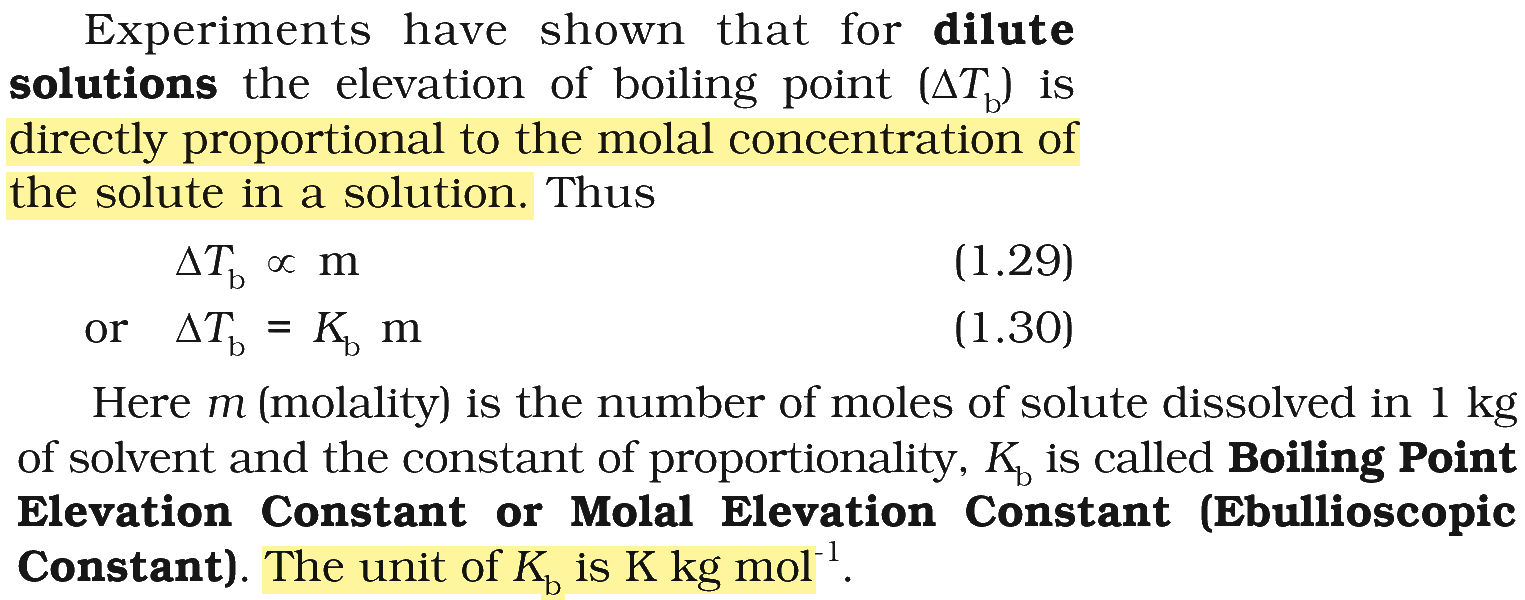
(C) The elevation of boiling point is directly proportional to the molal concentration of the solute in solution.
(D) Unit of Kb = K kg mol−1
Choose the correct answer from the options given below:
Answer & explanation
Correct answer: option 4
The correct answer is Option (4) → (A), (C) and (D) only
A liquid boils when its vapour pressure becomes equal to the atmospheric pressure. Adding a non-volatile solute lowers the vapour pressure of the solvent, so the solution has to be heated to a higher temperature before it boils. The rise in boiling point is the elevation of boiling point:
\( \displaystyle \Delta T_b=T_b-T_b^{\circ} \)
For dilute solutions it is directly proportional to the molality m of the solute:
\( \displaystyle \Delta T_b=K_b\,m \)
where Kb is the molal elevation (ebullioscopic) constant.
(A) The boiling point of a solution is always higher than the boiling point of the pure solvent in which the solution is prepared. — Correct. The lower vapour pressure of the solution means a higher temperature is needed to reach atmospheric pressure.
(B) The boiling point of a solution is always lower than the boiling point of the pure solvent in which the solution is prepared. — Incorrect. This is the opposite of (A); it is the freezing point, not the boiling point, that is lowered.
(C) The elevation of boiling point is directly proportional to the molal concentration of the solute in solution. — Correct. This is the relation ΔTb = Kbm.
(D) Unit of Kb = K kg mol−1 — Correct. Kb is the elevation per unit molality:
\( \displaystyle K_b=\frac{\Delta T_b}{m}=\frac{\mathrm{K}}{\mathrm{mol\,kg^{-1}}}=\mathrm{K\,kg\,mol^{-1}} \)
NCERT (2026-27 edition):
Elevation of Boiling Point – …