
System of linear equations \(2x+4y+1=0\) and \(4x+8y+2=0\) has/have:
Answer & explanation
Correct answer: option 2
The correct answer is Option (2) → Infinitely many solutions
For a pair of linear equations \(a_1x+b_1y+c_1=0\) and \(a_2x+b_2y+c_2=0\), the ratios of the coefficients decide the number of solutions. If all three ratios are equal, \(\frac{a_1}{a_2}=\frac{b_1}{b_2}=\frac{c_1}{c_2}\), the second equation is the first one multiplied by a number, so both give the same line and every point on it is a solution.
\(\displaystyle\frac{a_1}{a_2}=\frac{2}{4}=\frac{1}{2}\) and \(\displaystyle\frac{b_1}{b_2}=\frac{4}{8}=\frac{1}{2}\)
\(\displaystyle\frac{c_1}{c_2}=\frac{1}{2}\), also equal: the second equation is twice the first, so the lines coincide
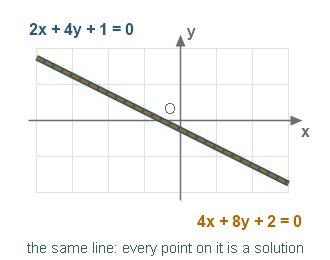
Why the other options are incorrect
Option (1) No solution — Incorrect. That needs \(\frac{a_1}{a_2}=\frac{b_1}{b_2}\ne\frac{c_1}{c_2}\), parallel lines; here the third ratio is equal too.
Option (3) Unique solution (0, 0) — Incorrect. There is no single solution, and \((0,0)\) gives \(2(0)+4(0)+1=1\ne0\), so it does not even lie on the line.
Option (4) Unique solution (1, −5) — Incorrect. \(2(1)+4(-5)+1=-17\ne0\), so \((1,-5)\) is not on the line either.