The hybridization of allylic and benzylic carbon in allylic chloride and benzylic chloride, respectively, is:
Answer & explanation
Correct answer: option 3
The correct answer is Option (3) → sp3 and sp3
Halogen compounds are named by the kind of carbon atom that carries the halogen:
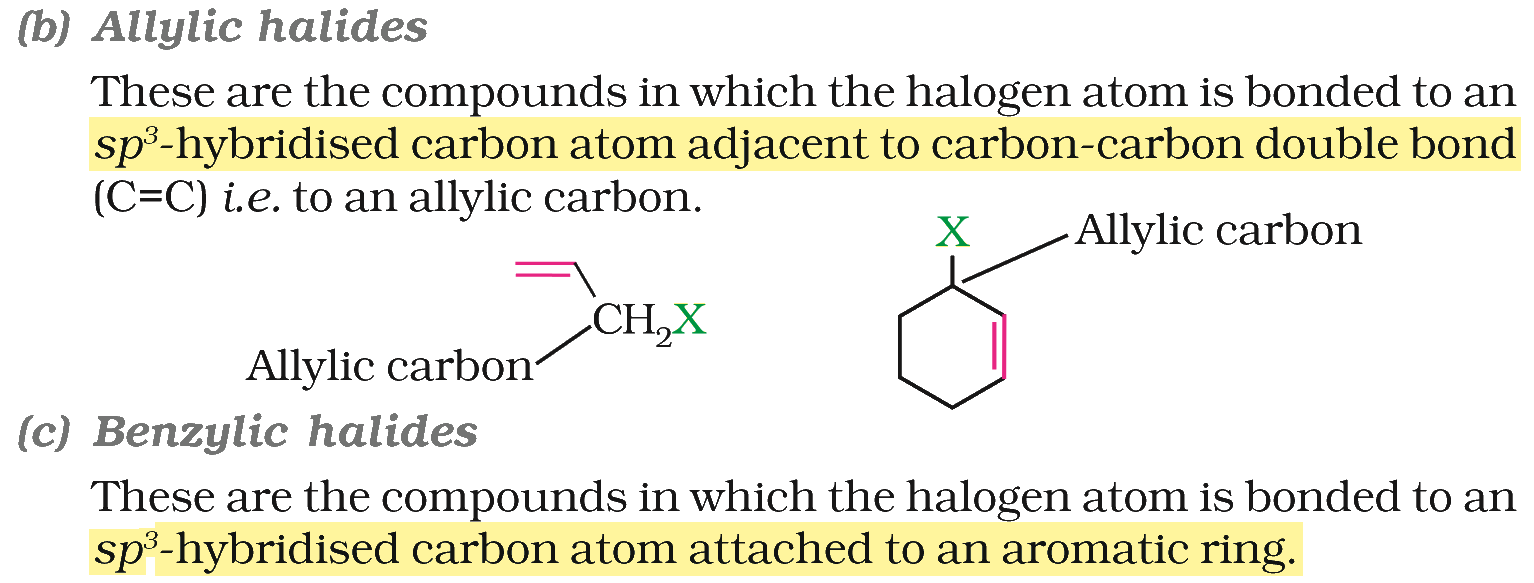
Allylic carbon: the carbon next to a C=C double bond, as in allyl chloride, \( \ce{CH2=CH-CH2-Cl} \).
Benzylic carbon: the carbon attached to a benzene ring, as in benzyl chloride, \( \ce{C6H5-CH2-Cl} \).
Vinylic carbon: a carbon of the C=C bond itself, as in vinyl chloride, \( \ce{CH2=CH-Cl} \).
Aryl carbon: a carbon of the benzene ring itself, as in chlorobenzene, \( \ce{C6H5-Cl} \).
The allylic and benzylic carbons form only single bonds (to the ring or the C=C carbon, to two H atoms and to Cl). A carbon with four single bonds is sp3 hybridised. Vinylic and aryl carbons are part of a double bond or ring and are sp2.
So the allylic and benzylic carbons are sp3 and sp3.
Why the other options are incorrect
Option (1) sp2 and sp3 — Incorrect. sp2 would be a vinylic carbon, not an allylic one.
Option (2) sp3 and sp2 — Incorrect. sp2 would be an aryl carbon of the ring, not the benzylic \( \ce{CH2} \).
Option (4) sp2 and sp2 — Incorrect. These are the hybridisations of the carbons in vinyl chloride and chlorobenzene.
NCERT (2026-27 edition):
Allylic Halides