
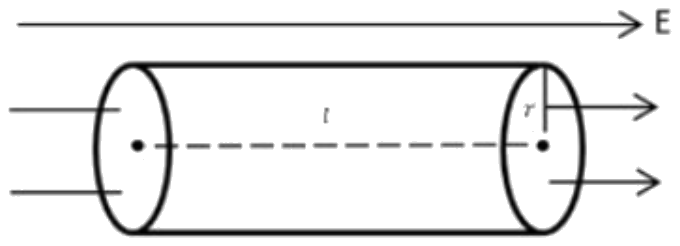
A cylinder of length \( l \) and radius \( r \) is placed in a uniform electric field \( \vec{E} \) with its axis parallel to the electric field as shown in the diagram given below. The net electric flux through the cylinder is
Answer & explanation
Correct answer: option 4
The correct answer is Option (4) → zero
Electric flux through a surface is \( \phi = \oint \vec{E}\cdot d\vec{A} \), and by Gauss’s law the net flux through a closed surface is \( q_{\mathrm{enc}}/\varepsilon_{0} \).
The cylinder encloses no charge, so the net flux is zero. Face by face, with the outward normal on each face:
Left face (outward normal opposite to \( \vec{E} \)): \( \phi_{1} = -E\pi r^{2} \)
Right face (outward normal along \( \vec{E} \)): \( \phi_{2} = +E\pi r^{2} \)
Curved surface (normal perpendicular to \( \vec{E} \)): \( \phi_{3} = 0 \)
\( \phi = -E\pi r^{2} + E\pi r^{2} + 0 = 0 \)
Note: This question is from NCERT (2026-27). NTA sets numerical questions from NCERT too, so do not ignore NCERT while practising numericals.
NCERT (2026-27):
Gauss’s Law – “… The law implies that the total electric flux through a closed surface is zero if no charge is enclosed by the surface.”
Gauss’s Law – “… Here the electric field is uniform and we are considering a closed cylindrical surface, with its axis parallel to the uniform field E.”
Gauss’s Law – “… Thus, the total flux is zero, as expected by Gauss’s law.”