
Match List-I with List-II
| List-I | List-II | ||
|---|---|---|---|
| (Statements, etc.) | (Values, etc.) | ||
| (A) | Coordinates of origin | (I) | (0, y) |
| (B) | Distance of a point from itself | (II) | (x, 0) |
| (C) | Any point on the y axis | (III) | (0, 0) |
| (D) | Any point on the x axis | (IV) | 0 |
Choose the correct answer from the options given below:
Answer & explanation
Correct answer: option 3
The correct answer is Option (3) → (A) - (III), (B) - (IV), (C) - (I), (D) - (II)
The coordinates \((x,y)\) of a point are its distances from the y-axis and the x-axis.
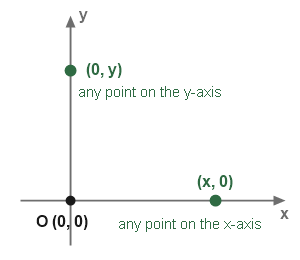
(A) Coordinates of origin — this matches (III) (0, 0). The origin is the point where the two axes cross, so it is at zero distance from both.
(B) Distance of a point from itself — this matches (IV) 0. A point is no distance away from itself; the distance formula gives \(\sqrt{0^{2}+0^{2}}=0\).
(C) Any point on the y axis — this matches (I) (0, y). A point on the y-axis is at no distance from it, so its x-coordinate is 0.
(D) Any point on the x axis — this matches (II) (x, 0). A point on the x-axis is at no distance from it, so its y-coordinate is 0.