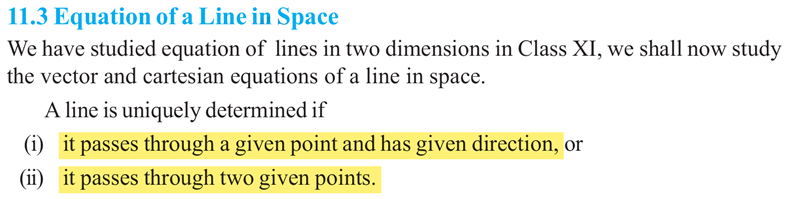
A line in space is uniquely determined if
(A) It passes through a given point and has a given direction.
(B) It passes through two given points.
(C) It passes through a given point.
(D) It has a given direction.
Choose the correct answer from the options given below:
Answer & explanation
Correct answer: option 2
The correct answer is Option (2) → (A) and (B) only
Through a point with position vector \( \vec{a} \) and parallel to \( \vec{b} \) there is exactly one line:
\( \displaystyle \vec{r}=\vec{a}+\lambda\vec{b} \)
Two distinct points \( \vec{a} \) and \( \vec{b} \) give the direction \( \vec{b}-\vec{a} \), so they also fix exactly one line:
\( \displaystyle \vec{r}=\vec{a}+\lambda(\vec{b}-\vec{a}) \)
So a line is fixed by a point together with a direction, or by two points; a point alone or a direction alone is not enough.
Checking the statements
(A) It passes through a given point and has a given direction. — Correct. The line is \( \vec{r}=\vec{a}+\lambda\vec{b} \).
(B) It passes through two given points. — Correct. The line is \( \vec{r}=\vec{a}+\lambda(\vec{b}-\vec{a}) \).
(C) It passes through a given point. — Incorrect. Infinitely many lines pass through one point.
(D) It has a given direction. — Incorrect. Infinitely many parallel lines have the same direction.
NCERT (2026-27 edition):
Equation of a Line in Space