Which of the following reagents is used for the oxidation of primary alcohol to carboxylic acid?
Answer & explanation
Correct answer: option 2
The correct answer is Option (2) → Jones reagent
A primary alcohol is oxidised in two stages: first to an aldehyde, then to a carboxylic acid. A strong oxidising agent takes it all the way to the acid; a mild one such as PCC stops at the aldehyde.
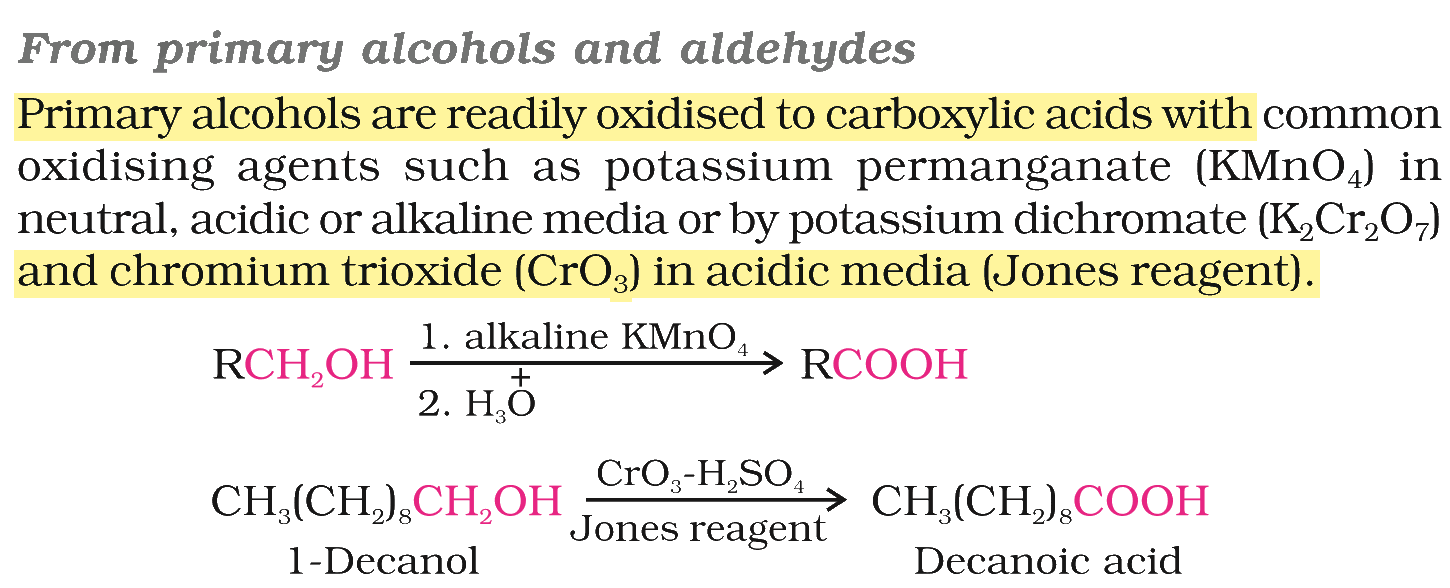
Jones reagent, chromium trioxide in aqueous sulphuric acid, is such a strong oxidising agent:
\( \displaystyle \ce{RCH2OH} \xrightarrow[\ce{H2SO4}]{\ce{CrO3}} \ce{RCOOH} \)
So the reagent used to oxidise a primary alcohol to a carboxylic acid is Jones reagent.
Why the other options are incorrect
Option (1) Grignard reagent — Incorrect. RMgX is a source of a carbon nucleophile, not an oxidising agent; it adds to carbonyl compounds and gives alcohols.
Option (3) Tollens’ reagent — Incorrect. Ammoniacal silver nitrate is a mild oxidising agent that oxidises aldehydes (silver mirror test) but not alcohols.
Option (4) Fehling’s reagent — Incorrect. The alkaline copper(II) complex oxidises aliphatic aldehydes (red precipitate of \( \ce{Cu2O} \)) but not alcohols.
NCERT (2026-27 edition):
From Primary Alcohols and Aldehydes