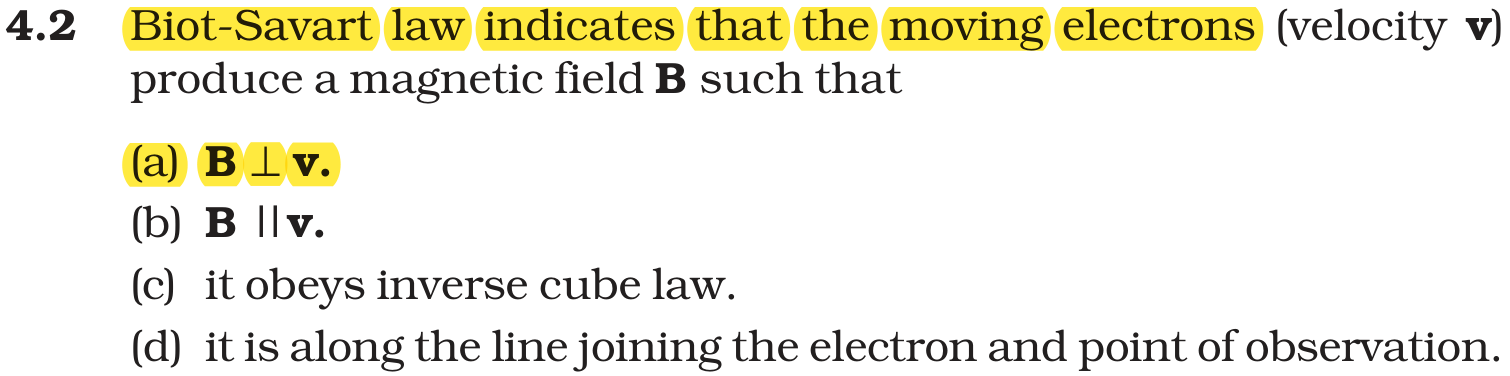
Biot-Savart law indicates that the moving electrons (velocity \( \vec{v} \)) produce a magnetic field (\( \vec{B} \)) such that:
Answer & explanation
Correct answer: option 3
The correct answer is Option (3) → \( \vec{B} \) is at right angle to \( \vec{v} \).
For a moving charge the Biot-Savart law gives the field at a point at displacement \( \vec{r} \) from it:
\( \displaystyle \vec{B} = \frac{\mu_0}{4\pi}\,\frac{q\,\vec{v}\times\vec{r}}{r^{3}} \)
Because \( \vec{B} \) is along the cross product \( \vec{v}\times\vec{r} \), it is perpendicular to both \( \vec{v} \) and \( \vec{r} \).
Option (1) \( \vec{B} \) obeys inverse cube law. — Incorrect. Since \( |\vec{r}| \) in the numerator cancels one power of \( r^{3} \), the magnitude is \( \mu_0qv\sin\theta/4\pi r^{2} \): an inverse square law.
Option (2) \( \vec{B} \) is along the line joining the electron and the field point. — Incorrect. \( \vec{B} \) is perpendicular to \( \vec{r} \), the line joining the charge and the field point.
Option (3) \( \vec{B} \) is at right angle to \( \vec{v} \). — Correct. A cross product is perpendicular to each of its factors, so \( \vec{B} \perp \vec{v} \).
Option (4) \( \vec{B} \) is parallel to \( \vec{v} \). — Incorrect. For \( \vec{B} \) parallel to \( \vec{v} \) the cross product would have to lie along \( \vec{v} \), which is impossible.
Note: A similar question was also asked in CUET (UG) 2023 on 14-06-2023 (Slot 3).
NCERT Exemplar:
Moving Charges and Magnetism – …