Calculate the equilibrium income when MPC = .25 and transfers increases by 50.
Answer & explanation
Correct answer: option 3
The correct answer is Option (3) → 16.67
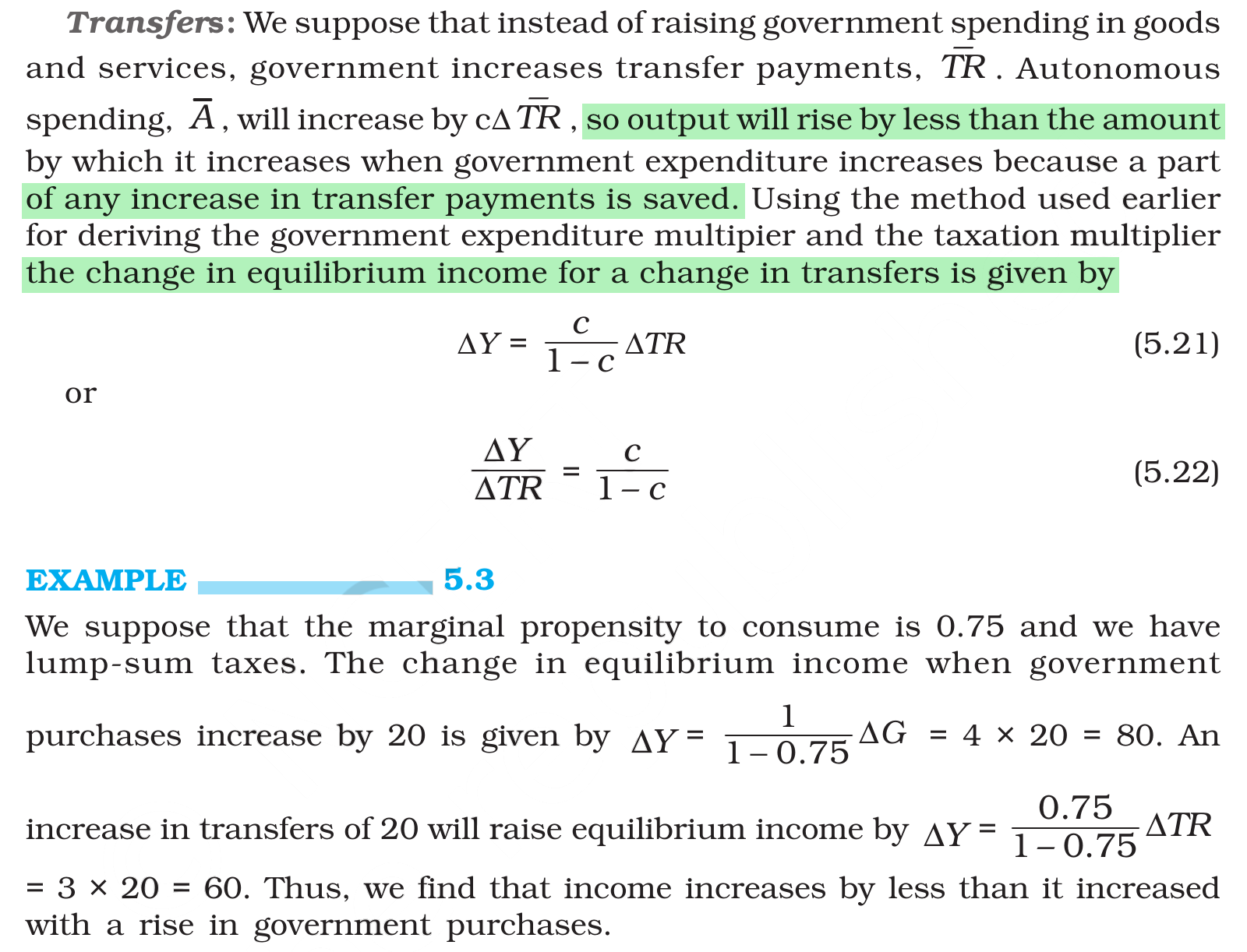
A transfer payment, such as a pension or a scholarship, buys no goods itself; it adds to the disposable income of households. They spend the fraction c of it and save the rest, so demand first rises by cΔTR, not by the whole ΔTR, and income then grows through the multiplier. Together this gives the transfer multiplier, c/(1 − c).
Given:
Marginal propensity to consume, c = 0.25
Increase in transfers, ΔTR = 50
Working it out:
ΔY = c/(1 − c) × ΔTR
c/(1 − c) = 0.25/0.75 = 1/3
ΔY = 1/3 × 50 = 16.67, which is Option (3)
Had the government spent the 50 on goods and services, the whole amount would have entered aggregate demand and income would have risen by 50/(1 − 0.25) = 66.67, the figure in Option (2). Transfers raise income by less, because a part of every transfer is saved.
Note: It seems that there is a mistake in the original NTA paper, which asks for ‘the equilibrium income’ when it should ask for ‘the change in equilibrium income’. No autonomous consumption or investment is given, so the level of income cannot be found; the MPC and the increase in transfers give only the change in income, which is what the options show.
NCERT: Introductory Macroeconomics — Chapter 5: Government Budget and the Economy (2025-26)
|