What are the products formed when sucrose in alcoholic solution is boiled with dilute H2SO4?
Answer & explanation
Correct answer: option 2
The correct answer is Option (2) → Glucose and fructose
Disaccharides are made of two monosaccharide units joined by a glycosidic linkage. On hydrolysis with dilute acid (or enzymes) they give back their monosaccharides:
Sucrose: α-D-glucose + β-D-fructose.
Maltose: two units of α-D-glucose.
Lactose: β-D-galactose + β-D-glucose.
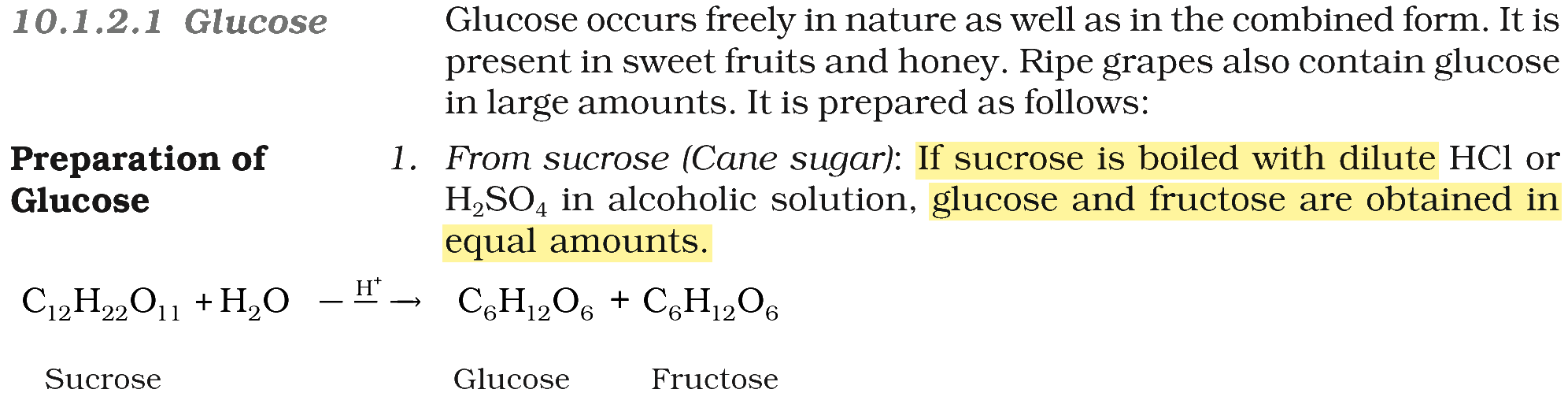
Boiling sucrose with dilute \( \ce{H2SO4} \) (or HCl) in alcoholic solution hydrolyses it into equal amounts of glucose and fructose:
\( \displaystyle \ce{C12H22O11 + H2O} \xrightarrow{\ce{H^+}} \ce{C6H12O6 + C6H12O6} \quad \text{(glucose + fructose)} \)
Sucrose is dextrorotatory, but the mixture formed is laevorotatory, because fructose (−92.4°) rotates more strongly to the left than glucose (+52.5°) rotates to the right. So the product is called invert sugar.
Why the other options are incorrect
Option (1) Glucose and galactose — Incorrect. These are the hydrolysis products of lactose (milk sugar).
Option (3) Galactose and fructose — Incorrect. Sucrose contains no galactose unit.
Option (4) Glucose and gluconic acid — Incorrect. Gluconic acid is formed by oxidation of glucose (e.g. with bromine water), not by hydrolysis of sucrose.
NCERT (2026-27 edition):
Preparation of Glucose