
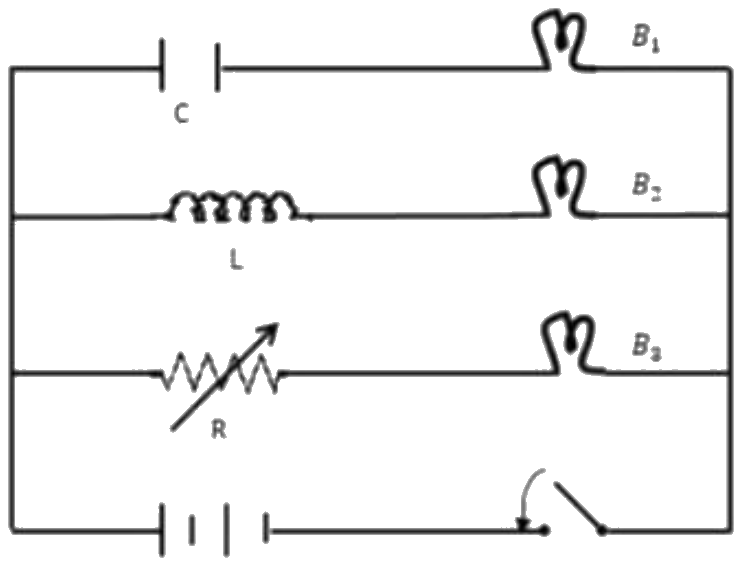
What would happen when key is closed in the following circuit?
Answer & explanation
Correct answer: option 1
The correct answer is Option (1) → Bulb \( B_1 \) lights up earliest with full brightness.
Just after the key is closed, each branch behaves according to how its element responds to a sudden change, all three branches being connected directly across the battery.
An uncharged capacitor has no voltage across it at the first instant, so it acts like a plain connecting wire: the full battery voltage appears across \( B_1 \) and a large charging current flows. (The current then decays as the capacitor charges, and \( B_1 \) goes off.)
An inductor opposes the growth of current through its self-induced back emf \( -L\,dI/dt \), so the current in the \( B_2 \) branch starts from zero and rises gradually: \( B_2 \) lights up late.
The \( B_3 \) branch contains only resistance, so its current appears at once, but the rheostat \( R \) in series limits it, so \( B_3 \) glows at reduced brightness.
So only \( B_1 \) lights up at once with full brightness.
Note: This question is from beyond the NCERT textbook and it appears to be out of the CUET 2026 Physics syllabus.