CUETMOCK
  • Pricing
  • Mentors
Log inStart freeStart free mocks→

First test, then trust

Try a free CUET mock test.

Join 5,00,000+ students who rehearsed exam day on the exact NTA screen before sitting CUET. On the web and on Android.

Start free mocks →Get the Android app
CUETMOCK

India's #1 CUET Mock Test Platform. Original NCERT-based questions on the exact NTA exam screen — trusted by 5,00,000+ students since CUET 2022.

Get it onGoogle PlayScan to download the CUETMOCK app

Mock tests

  • CUET mock test series
  • Commerce mocks
  • Humanities (Arts) mocks
  • Science mocks
  • Languages & GAT mocks
  • Free practice questions
  • Pricing

Resources

  • CUET exam guide
  • CUET syllabus
  • Universities accepting CUET
  • Expert blogs
  • News & notifications
  • Webinars & counselling
  • CUET score calculator
  • How we estimate your rank
  • FAQs

Company

  • About us
  • Our leadership & team
  • Our toppers
  • Mentors
  • For schools
  • Contact us
  • Terms
  • Privacy
  • Refund policy

Talk to us

+91 7696 6630 56info@cuetmock.comWhatsApp us

Our other platforms

  • JEE Mock — For IIT-JEE aspirants
  • NEET Mock — For NEET aspirants

Newsletter

Exam updates, study material and offers — no spam.

© 2026 NYC Ventures Pvt. Ltd.

701-702, Royal Business Park, Zirakpur, Punjab - 140603

  • Terms of use
  • Privacy policy
  • Refund policy
  • Contact us

iCUETMOCK is an independent preparation platform, not affiliated with the National Testing Agency (NTA). Always check exam details on the official NTA website.

  • Home
  • Mock tests
  • CUET guide
  • Pricing
  • Log in
Home/Practice questions/Biology
BiologyBiotechnology -Principles and Processes

Restriction endonuclease cuts each of two strands of DNA at specific…

Recombinant DNA technology

Read the following passage carefully and answer the given questions

Biotechnology has been used by humans since times immemorial in the form of unmodified microbe mediated processes. However, rDNA technology uses genetically modified organisms and employs number of tools. The key tools are restriction enzymes, polymerase enzymes, ligases, vectors and the host organism. Restriction enzymes are also called as nucleases as they cut the DNA. Exonucleases cuts the DNA from the ends whereas endonucleases cuts the DNA at specific positions within the DNA. Endonucleases recognize a sequence of six base pairs called ‘recognition sequence’. Restriction enzymes cut both foreign DNA and vector DNA at specific point. Plasmids and bacteriophages are the commonly used vectors for transferring rDNA into the host organism. Vectors used now a days are engineered in such a way that help in easy linking with foreign DNA as well as selection of recombinants from non-recombinants. Maintenance of introduced DNA in the host and transfer of DNA to its progeny is one of the basic step of biotechnology.

Restriction endonuclease cuts each of two strands of DNA at specific point in form of a sequence called as -

Answer & explanation+

Correct answer: option 4

The correct answer is Option (4) → Palindromic sequence

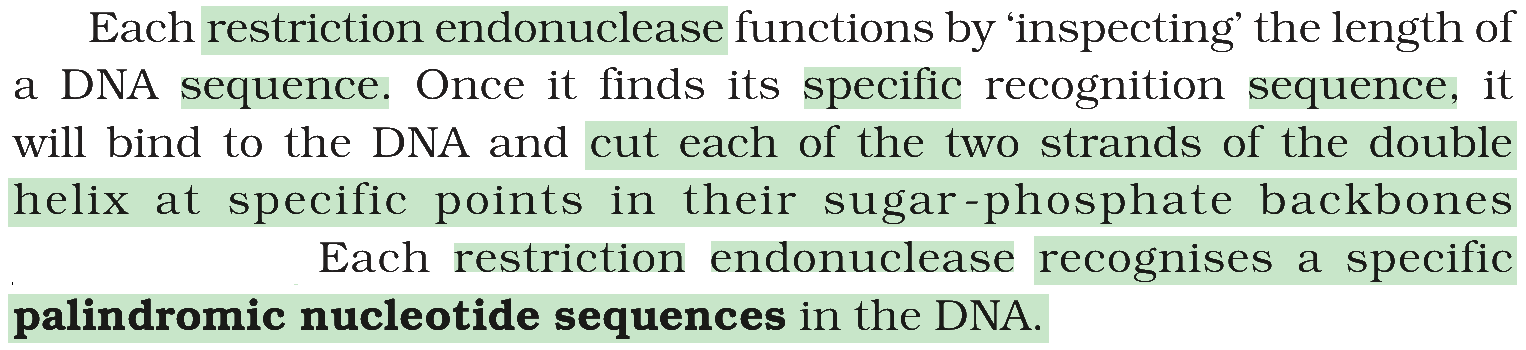
A restriction endonuclease first finds its recognition sequence on the DNA. It then cuts each of the two strands at specific points. The recognition sequence is a palindromic nucleotide sequence. In DNA, a palindrome is a sequence of base pairs that reads the same on the two strands when both are read in the same direction, for example 5′-GAATTC-3′.

(1) UTR — Incorrect. UTR stands for untranslated regions. These are the parts at both ends of an mRNA that are not translated into protein.

(2) Satellite DNA — Incorrect. This is repetitive DNA that makes up a large part of the genome. It is not where restriction enzymes cut.

(3) Promoter — Incorrect. This is the site where RNA polymerase binds to begin transcription.

(4) Palindromic sequence — Correct. This is the sequence that restriction endonucleases recognise.

Note: The passage is taken from NCERT. NTA has put lines of the NCERT text together to make it. Most CUET (UG) questions come straight from NCERT, so study the book line by line, including figures and their titles.

NCERT Extract:
Restriction Enzymes –
Textbook extract

Textbook figure

Advertisement

Practise more on Biotechnology -Principles and Processes

Chapter-wise mocks on the real NTA exam screen, with solutions and your rank. Your first mocks are free.

Start free mocks →

Advertisement

Next questions

  1. Match List-I (Excel Function) with List-II (Use)List-I(A) CUMIPMT(B) PV(C) PMT(D) NPVList-II(I) This function returns the present value of…Accountancy Part C · Spreadsheet
  2. Which class of following compound react with 2,4-DNP reagent to form an orange-red precipitate?Chemistry · Organic: Aldehydes, Ketones and Carboxylic Acids
  3. Characteristics such as hardworking, sincere, warm, loving and empathetic can also be called __________.Psychology · Self and Personality
  4. The kinetic energy of an electron in ground level in hydrogen atom is K units. The values of potential energy and total energy, respectivel…Physics · Atoms
  5. A box has 5 blue and 4 red balls. One ball is drawn at random and not replaced. Its colour is also not noted, then another ball is drawn at…Maths. Section A · Probability (Section A)
  6. Choose the appropriate word from the options given to complete the following sentence.Fortunately, her parents were ________unaware of what…English · Fill Blanks
  7. Rearrange the following parts of a sentence to make a meaningful sentence:A. the local language and see how yourB. travel to a foreign coun…English · Arrange in Meaningful Sequence
  8. The binding energy per nucleon of a nucleus (A = 240) is 7.8 MeV. If it breaks into two equal fragments, each of A = 120 and binding energy…Physics · Nuclei
  9. If m is the order and n is degree of differential equations, thenMatch List-I with List-IIList-IList-II(Differential Equation)(2m + n)(A) ≤…Maths. Section A · Differential Equations
  10. The total expenditure on a commodity rises from Rs.100 to Rs.150 as a result of an increase in the price of the commodity from Rs. 10 to Rs…Economics · Micro Economics: Theory of Consumer behaviour