Which class of following compound react with 2,4-DNP reagent to form an orange-red precipitate?
Answer & explanation
Correct answer: option 4
The correct answer is Option (4) → Aldehydes and ketones
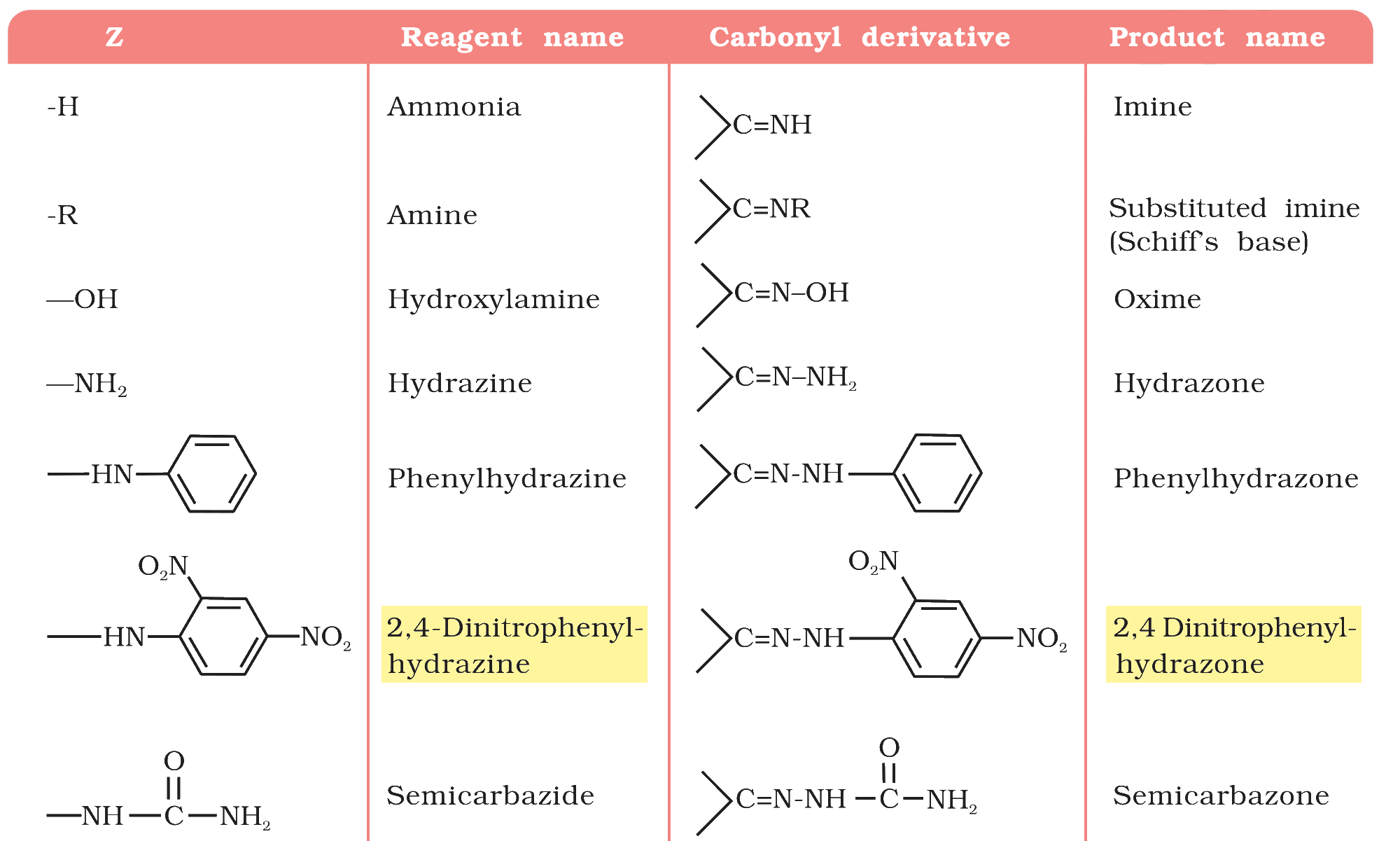
2,4-DNP (2,4-dinitrophenylhydrazine) is a derivative of ammonia, H2N–Z. Like other ammonia derivatives, it adds to the C=O group of aldehydes and ketones, and the adduct then loses water to form a C=N bond. The product, a 2,4-dinitrophenylhydrazone, separates as a yellow, orange or red precipitate:
\( \displaystyle \ce{R2C=O + H2N-NH-C6H3(NO2)2 -> R2C=N-NH-C6H3(NO2)2 + H2O} \)
Any compound with the carbonyl group of an aldehyde or a ketone gives this test, so the class that reacts is aldehydes and ketones. The C=O group of carboxylic acids and esters is stabilised by resonance and does not give the test.
Why the other options are incorrect
Option (1) Alcohol and Phenols — Incorrect. They contain an –OH group but no C=O group, so they do not react with 2,4-DNP.
Option (2) Ketones only — Incorrect. Aldehydes react as well, because they have the same C=O group.
Option (3) Aldehyde only — Incorrect. Ketones react as well. To tell an aldehyde from a ketone, Tollens’ or Fehling’s test is used instead.
NCERT (2026-27 edition):
Addition of Ammonia and Its Derivatives – …