The following reaction is catalysed by
2I− + S2O82− → I2 + 2SO42−
Answer & explanation
Correct answer: option 2
The correct answer is Option (2) → Fe(III)
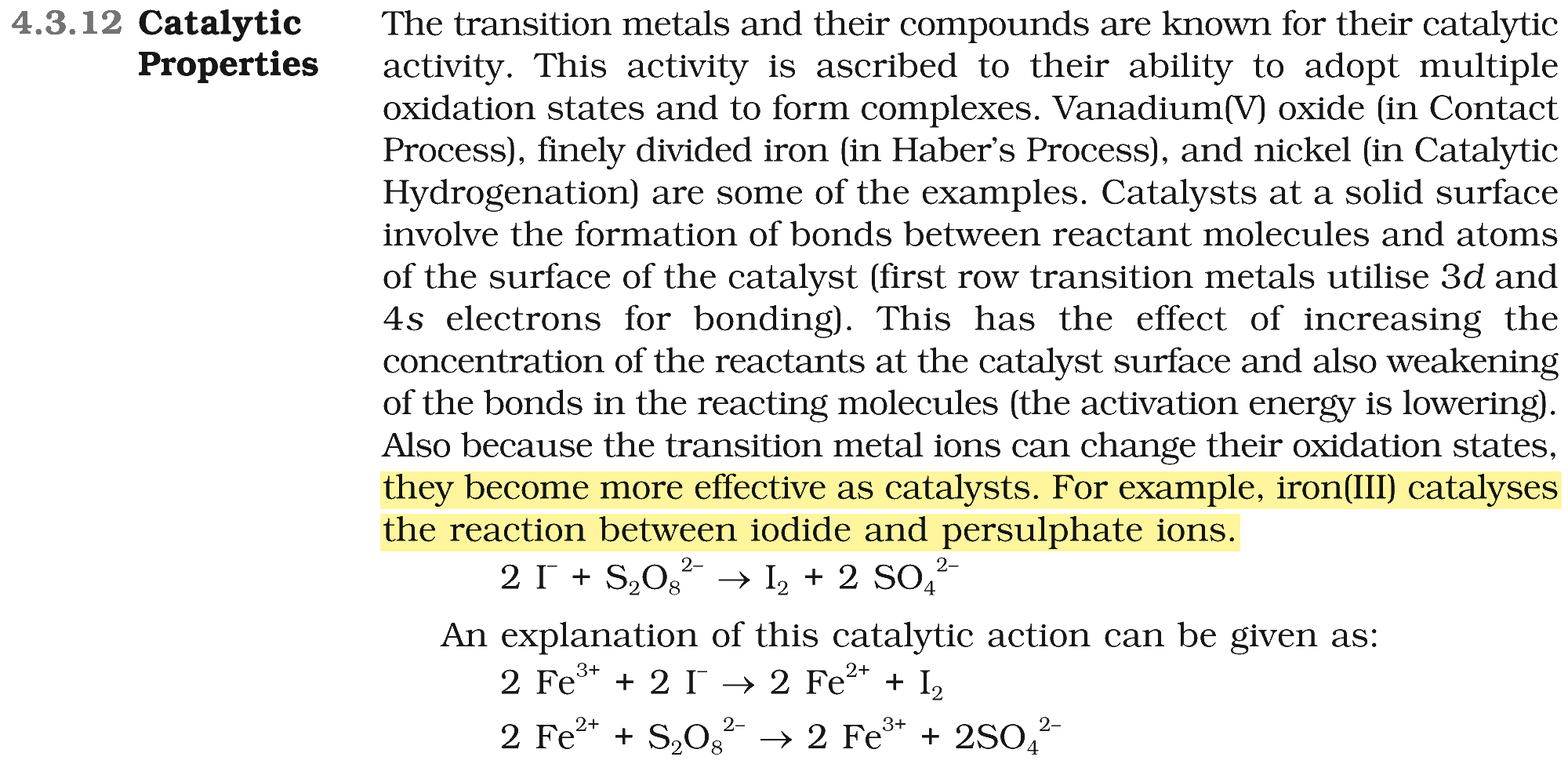
Transition metals and their ions are good catalysts because they can show several oxidation states and switch easily between them. The catalyst takes part in the reaction and is regenerated at the end.
The reaction between iodide and persulphate ions is slow because both reactants are negative ions and repel each other. Iron(III) ions act as a go-between: \( \ce{Fe^3+} \) oxidises \( \ce{I^-} \) to \( \ce{I2} \) and is reduced to \( \ce{Fe^2+} \), and persulphate then oxidises \( \ce{Fe^2+} \) back to \( \ce{Fe^3+} \). Each step is between oppositely charged ions, and the two steps add up to the given reaction, with \( \ce{Fe^3+} \) formed again at the end. So the reaction is catalysed by Fe(III).
Why the other options are incorrect
Option (1) V(III) — Incorrect. \( \ce{V^{3+}} \) is a reducing species, not an oxidant strong enough to oxidise \( \ce{I^{-}} \) to \( \ce{I2} \), so it cannot start this cycle.
Option (3) V(V) — Incorrect. Vanadium(V) oxide (\( \ce{V2O5} \)) is the catalyst in the Contact process for oxidising \( \ce{SO2} \) to \( \ce{SO3} \).
Option (4) Pd(II) — Incorrect. \( \ce{PdCl2} \) is the catalyst in the Wacker process for oxidising ethene to ethanal.
NCERT (2026-27 edition):
Catalytic Properties