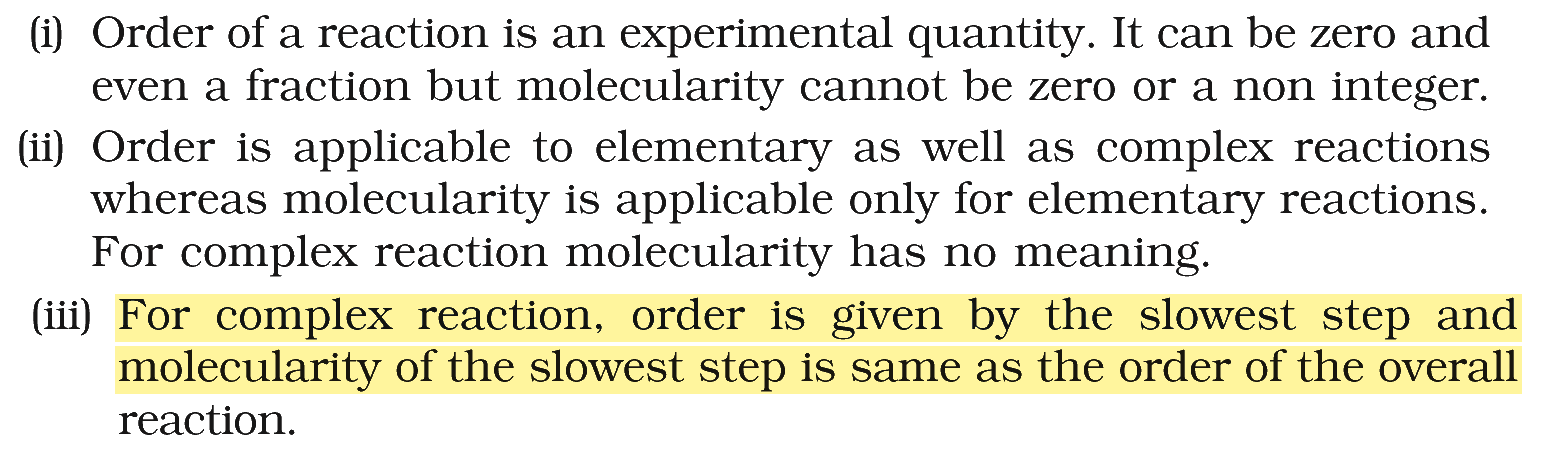
Which of the following is true for complex reactions?
Answer & explanation
Correct answer: option 3
The correct answer is Option (3) → Molecularity of the slowest step is same as the order of the overall reaction.
A reaction that takes place in one step is an elementary reaction. A complex reaction takes place through a sequence of elementary steps. The rate of the whole reaction cannot be faster than the slowest step, so the slowest step is the rate determining step and the rate law, and hence the order, is decided by it.
Molecularity is the number of reacting species colliding in one elementary step. It has a meaning only for an elementary step; for the equation of a complex reaction as a whole it has no meaning.
For example, the decomposition of \( \ce{H2O2} \) catalysed by iodide ions takes place in two steps:
\( \displaystyle \ce{H2O2 + I^- -> H2O + IO^-}\quad\text{(slow)} \)
\( \displaystyle \ce{H2O2 + IO^- -> H2O + I^- + O2}\quad\text{(fast)} \)
\( \displaystyle \mathrm{Rate}=k[\ce{H2O2}][\ce{I^-}] \)
The slow step is bimolecular (molecularity 2), and the reaction as a whole is second order.
Why the other options are incorrect
Option (1) Order is given by the fastest step. — Incorrect. The fastest step does not limit the rate; the order is decided by the slowest step.
Option (2) Overall molecularity of the reaction is given by the fastest step. — Incorrect. Molecularity belongs to each elementary step separately; a molecularity of the whole reaction has no meaning for a complex reaction.
Option (4) Each step of a complex reaction is called a complementary reaction. — Incorrect. Each step is called an elementary reaction.
NCERT (2026-27 edition):
Molecularity of a Reaction – …