
DNA STRUCTURE
Read the following passage carefully and answer the given questions.
DNA is a long polymer of deoxyribonucleotides. A nucleotide has three components – a nitrogenous base, a pentose sugar, and a phosphate group. There are two types of nitrogenous bases – Purines and Pyrimidines. DNA is made of two polynucleotide chains, where the backbone is constituted by sugar-phosphate, and the bases project inside. The bases in two strands are paired through hydrogen bond forming base pairs. As a result, always a purine comes opposite to a pyrimidine. This generates approximately uniform distance between the two strands of the helix. The plane of one base pair stacks over the other in double helix. This, in addition to H-bonds, confers stability of the helical structure. The two polynucleotide chains are coiled in a right-handed fashion. In eukaryotes, the DNA organisation is much more complex. There is a set of positively charged, basic proteins called histones. A protein acquires charge depending upon the abundance of amino acids residues with charged side chains.
In DNA helix, the distance between two base pairs is:
Answer & explanation
Correct answer: option 2
The correct answer is Option (2) → 0.34 nanometer
A full turn of the double helix (the pitch) is 3.4 nm and holds about 10 base pairs. So the distance between two successive base pairs is 3.4 nm ÷ 10 = 0.34 nm.
Option (1), 3.4 nm, is the pitch of a whole turn, not the gap between two base pairs. The other numbers are not given by the structure of DNA.
Note: The passage is taken from NCERT. NTA has put lines of the NCERT text together to make it. Most CUET (UG) questions come straight from NCERT, so study the book line by line, including figures and their titles.
NCERT Extract:
Structure of Polynucleotide Chain – “… (iv) The two chains are coiled in a right-handed fashion. The pitch of the helix is 3.4 nm (a nanometre is one billionth of a metre, that is 10-9 m) and there are roughly 10 bp in each turn. Consequently, the distance between a bp in a helix is approximately 0.34 nm.”
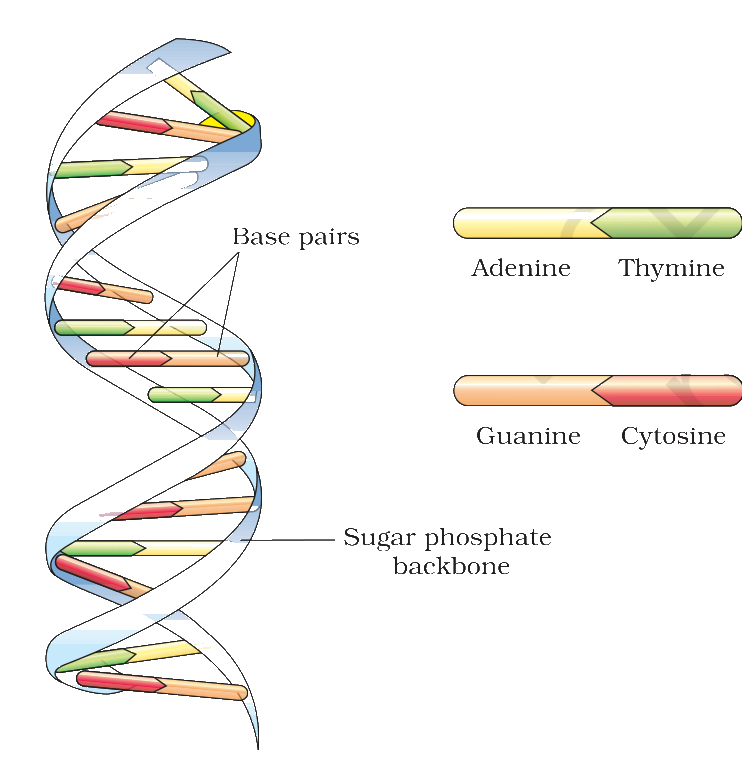
Figure 5.3 DNA double helix