
Identify the product [P] in the given sequence of reactions.
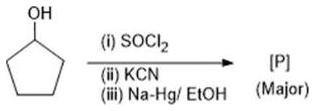
Answer & explanation
Correct answer: option 4
The correct answer is Option (4) → cyclopentylmethanamine
This sequence converts an alcohol into an amine with one more carbon atom. Replacing a halogen with cyanide adds a carbon, and reducing the nitrile turns the C≡N group into a –\( \ce{CH2NH2} \) group.
(i) SOCl2 replaces the –OH group by –Cl:
\( \displaystyle \ce{C5H9OH + SOCl2 -> C5H9Cl + SO2 + HCl} \)
(ii) KCN replaces –Cl by –CN (nucleophilic substitution), giving cyclopentanecarbonitrile:
\( \displaystyle \ce{C5H9Cl + KCN -> C5H9CN + KCl} \)
(iii) Na(Hg)/C2H5OH reduces the nitrile to a primary amine (Mendius reduction):
\( \displaystyle \ce{C5H9-C#N + 4Na(Hg) + 4C2H5OH -> C5H9-CH2NH2 + 4C2H5ONa} \)
(\( \ce{C5H9} \)– is the cyclopentyl group.) So [P] is cyclopentylmethanamine, structure 4.
Why the other options are incorrect
Option (1) cyclopentylacetic acid — Incorrect. This is \( \ce{C5H9-CH2-COOH} \). No step forms a –COOH group: Na(Hg)/\( \ce{C2H5OH} \) reduces the nitrile to –\( \ce{CH2NH2} \). Hydrolysing the nitrile would give cyclopentanecarboxylic acid, \( \ce{C5H9-COOH} \), which still is not this structure:
\( \displaystyle \ce{C5H9-C#N + 2H2O + H+} \xrightarrow{\Delta} \ce{C5H9-COOH + NH4+} \)
Option (2) cyclopentanamine — Incorrect. This has no extra carbon; the –CN step adds one carbon, which stays in the product as –\( \ce{CH2} \)–.
Option (3) (chloromethyl)cyclopentane — Incorrect. No step puts back a chlorine; the chloride made in step (i) is chlorocyclopentane, with no \( \ce{CH2} \), and it is used up in step (ii).
NCERT (2026-27 edition):
Reduction of Nitriles
